





Support center +91 97257 89197

Written by Pranav Begade
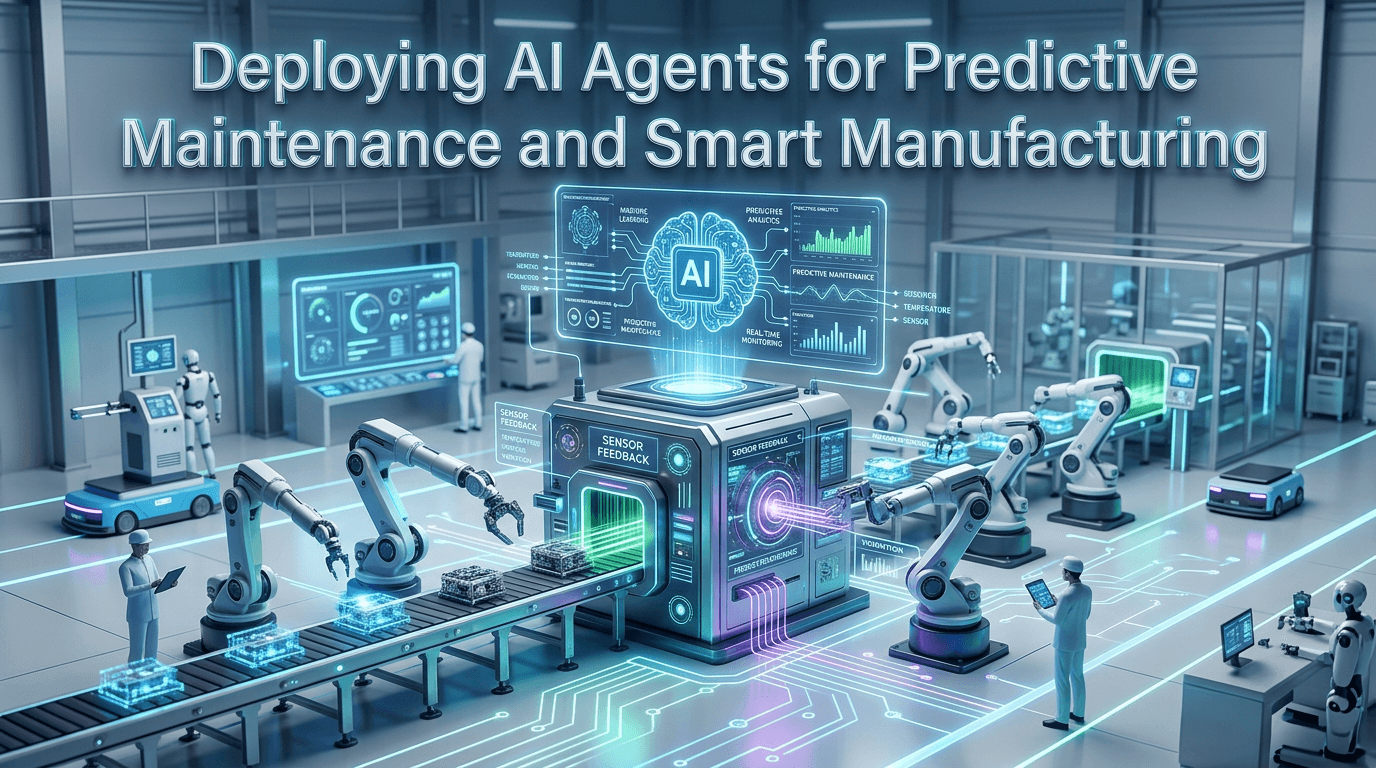
The manufacturing industry stands at a pivotal moment where artificial intelligence is no longer a futuristic concept but a present-day necessity. As factories become increasingly connected and data-driven, the integration of AI agents for predictive maintenance has emerged as a game-changing strategy for organizations seeking competitive advantages in smart manufacturing.
Traditional maintenance approaches—reactive repairs after failures occur or scheduled preventive maintenance based on fixed intervals—are proving insufficient for modern industrial operations. Unplanned downtime costs manufacturers billions annually, while over-maintenance wastes resources and still fails to prevent unexpected failures. AI-powered predictive maintenance offers a sophisticated alternative, enabling organizations to anticipate equipment failures before they happen, optimize maintenance schedules, and maximize operational efficiency.
Sapient Code Labs has been at the forefront of developing intelligent AI solutions that transform how manufacturers approach equipment maintenance and operational excellence. This comprehensive guide explores the deployment of AI agents for predictive maintenance in smart manufacturing environments.
AI agents are autonomous or semi-autonomous software systems that can perceive their environment, reason about complex situations, make decisions, and take actions to achieve specific goals. In manufacturing contexts, these intelligent systems analyze vast amounts of data from sensors, equipment logs, and operational systems to identify patterns, detect anomalies, and predict future states.
Modern AI agents for manufacturing go beyond simple rule-based systems. They employ machine learning algorithms, deep learning neural networks, and advanced analytics to continuously improve their predictions and recommendations. These agents can process structured data from programmable logic controllers (PLCs) and unstructured data from maintenance logs, operator notes, and even visual inspections.
The architecture of AI agents in manufacturing typically includes several key components: data ingestion pipelines that collect information from diverse sources, edge computing capabilities for real-time processing, cloud-based machine learning models for complex analysis, and integration layers that connect with existing manufacturing execution systems (MES) and enterprise resource planning (ERP) platforms.
Predictive maintenance powered by AI agents represents a fundamental shift from time-based or condition-based maintenance strategies. Instead of maintaining equipment on fixed schedules or reacting to obvious failure symptoms, AI systems predict when maintenance should be performed based on the actual condition of equipment and sophisticated analysis of failure patterns.
The process begins with comprehensive data collection. Sensors deployed throughout the manufacturing environment capture vibration data, temperature readings, current fluctuations, oil quality metrics, and countless other parameters. This sensor data, combined with historical maintenance records, production schedules, and operational context, creates a rich dataset for AI analysis.
AI agents process this data through multiple stages. Initially, they establish baseline patterns of normal equipment behavior. Then, they continuously monitor incoming data streams, comparing real-time measurements against these baselines. When deviations occur, the systems assess whether these variations indicate developing problems that could lead to failure.
Machine learning models trained on historical failure data can identify subtle precursor patterns that human analysts might miss. For instance, a slight increase in motor vibration combined with a specific temperature trend and changes in power consumption patterns might indicate bearing degradation that will result in failure within days or weeks. The AI agent quantifies the probability of failure, estimates the time remaining before failure occurs, and recommends optimal maintenance actions.
The implementation of AI agents for predictive maintenance delivers substantial benefits across multiple dimensions of manufacturing operations.
Dramatic Reduction in Unplanned Downtime represents the most immediate and visible benefit. Unplanned equipment failures can halt entire production lines, creating cascading effects throughout the operation. AI predictive maintenance can reduce unplanned downtime by 50% or more by identifying problems early enough for planned interventions.
Extended Equipment Lifespan results from optimized maintenance practices. When maintenance is performed based on actual equipment condition rather than arbitrary schedules, components are neither over-maintained nor pushed beyond their useful life. This approach can extend average equipment lifespan by 20-40% while reducing maintenance costs.
Significant Cost Savings emerge from multiple sources. Organizations reduce expenditures on emergency repairs, spare parts inventory, and overtime labor. More importantly, they avoid the hidden costs of production losses, quality defects caused by failing equipment, and safety incidents. The return on investment for predictive maintenance systems typically exceeds 10:1 for most manufacturing operations.
Improved Production Quality becomes achievable when equipment operates at optimal conditions. AI systems can detect subtle degradation that affects product quality before visible defects appear, enabling proactive adjustments that maintain consistent output quality.
Enhanced Worker Safety results from reducing the likelihood of catastrophic equipment failures and enabling maintenance teams to perform repairs under controlled conditions rather than emergency responses.
Successful deployment of AI agents for predictive maintenance requires thoughtful planning and execution. Organizations should approach implementation as a transformation initiative rather than a simple technology deployment.
Start with Critical Assets rather than attempting to monitor everything simultaneously. Identify the equipment that causes the most downtime, represents the highest repair costs, or creates the greatest production impact. Beginning with these high-value targets demonstrates value quickly and builds organizational confidence in the technology.
Ensure Data Quality and Coverage forms the foundation of effective AI predictions. Poor quality or incomplete data produces unreliable predictions regardless of algorithm sophistication. Organizations must invest in sensor infrastructure, data integration, and governance processes that ensure accurate, complete, and timely data availability.
Build Cross-Functional Teams that include maintenance expertise, operations knowledge, data science capabilities, and IT integration skills. Predictive maintenance success requires collaboration between these domains to ensure AI insights translate into effective maintenance actions.
Implement Incrementally with clear success metrics and validation processes. Each phase should prove value and refine understanding before expanding scope. This approach manages risk while building organizational capability and confidence.
Integrate with Existing Systems including maintenance management software, production scheduling tools, and enterprise systems. AI predictions must flow seamlessly into the workflows where maintenance decisions are made and executed.
AI-powered predictive maintenance finds application across diverse manufacturing sectors, each with unique requirements and benefit profiles.
In discrete manufacturing, AI agents monitor CNC machines, robotic arms, and assembly line equipment. A major automotive components manufacturer reduced unplanned downtime by 65% after deploying AI monitoring on critical machining centers, saving millions in avoided production losses.
In process industries such as chemical and pharmaceutical manufacturing, AI systems track pumps, compressors, heat exchangers, and other process-critical equipment. Predictive capabilities enable these facilities to maintain continuous operations while meeting stringent quality and safety requirements.
In food and beverage production, predictive maintenance helps maintain the high reliability required for perishable goods and stringent sanitation requirements. Equipment failures in these environments can result in product losses and contamination risks that AI monitoring helps prevent.
Energy utilities applying predictive maintenance to wind turbines, solar installations, and grid equipment are achieving remarkable results in maximizing renewable energy production and reducing maintenance costs across geographically distributed assets.
The evolution of AI agents in manufacturing continues accelerating, with emerging capabilities promising even greater transformation.
Digital Twin Integration combines predictive maintenance with sophisticated virtual representations of physical assets. AI agents operating on digital twins can simulate maintenance scenarios, predict outcomes of different interventions, and optimize long-term asset strategies.
Autonomous Maintenance represents an evolutionary endpoint where AI agents not only predict failures but initiate and execute appropriate responses. While fully autonomous maintenance remains aspirational for most organizations, advances in robotics and AI are making this future increasingly realistic.
Federated Learning enables AI models to improve collaboratively across organizations without sharing sensitive operational data. This approach promises to accelerate AI capability development while addressing data privacy and competitive concerns.
Edge AI processing allows more sophisticated analysis to occur directly on manufacturing equipment, reducing latency and enabling real-time responses to emerging conditions.
Organizations that establish foundational capabilities in AI-powered predictive maintenance today position themselves to leverage these emerging opportunities as they mature.
The deployment of AI agents for predictive maintenance represents a fundamental advancement in smart manufacturing capabilities. By transforming maintenance from a reactive cost center into a strategic competitive advantage, AI-powered approaches enable manufacturers to maximize equipment utilization, reduce operational costs, improve product quality, and enhance worker safety.
The journey toward predictive maintenance excellence requires commitment to data quality, cross-functional collaboration, and incremental implementation that demonstrates value while building organizational capability. Organizations that approach this transformation strategically will reap substantial rewards as AI capabilities continue advancing.
Sapient Code Labs specializes in developing custom AI solutions that address the unique challenges of predictive maintenance in manufacturing environments. Our team combines deep expertise in artificial intelligence with extensive experience in industrial operations to deliver solutions that integrate seamlessly with existing systems and deliver measurable business results.
Whether you are beginning your predictive maintenance journey or seeking to enhance existing capabilities, the time to embrace AI-powered maintenance is now. The technology is mature, the benefits are proven, and the competitive advantages of early adoption are substantial.
Discover how AI agents are revolutionizing predictive maintenance in smart manufacturing, reducing downtime and optimizing operations.
AI-powered predictive maintenance uses artificial intelligence agents to analyze data from equipment sensors and historical maintenance records to predict when equipment failures will occur. Unlike traditional maintenance approaches that react to failures or follow fixed schedules, AI systems identify early warning signs of degradation and recommend maintenance before failures happen.
Predictive maintenance is crucial for smart manufacturing because it dramatically reduces unplanned downtime, extends equipment lifespan, and optimizes maintenance costs. In an era of highly interconnected manufacturing operations, even brief equipment failures can create cascading effects throughout production lines, making predictive capabilities essential for maintaining competitive operations.
AI agents detect potential failures by establishing baseline patterns of normal equipment behavior and continuously monitoring real-time sensor data for deviations. These systems analyze multiple parameters simultaneously—including vibration, temperature, current, pressure, and other relevant metrics—identifying subtle patterns that indicate developing problems. Machine learning models trained on historical failure data can recognize precursor patterns that would be difficult or impossible for human analysts to detect.
The primary benefits include up to 50% reduction in unplanned downtime, 20-40% extension of equipment lifespan, significant cost savings with typical ROI exceeding 10:1, improved production quality through early detection of degradation affecting product specifications, and enhanced worker safety by reducing catastrophic failure risks. These benefits compound over time as AI systems continuously improve their prediction accuracy.
Manufacturers should begin by identifying critical assets that cause the most downtime or represent highest repair costs. Ensure adequate sensor infrastructure and data quality before deploying AI solutions. Build cross-functional teams combining maintenance expertise with data science capabilities. Implement incrementally, starting with high-value equipment before expanding scope. Partner with experienced AI development firms like Sapient Code Labs to accelerate deployment and avoid common pitfalls.
Work with us

