





Support center +91 97257 89197

Written by Pranav Begade
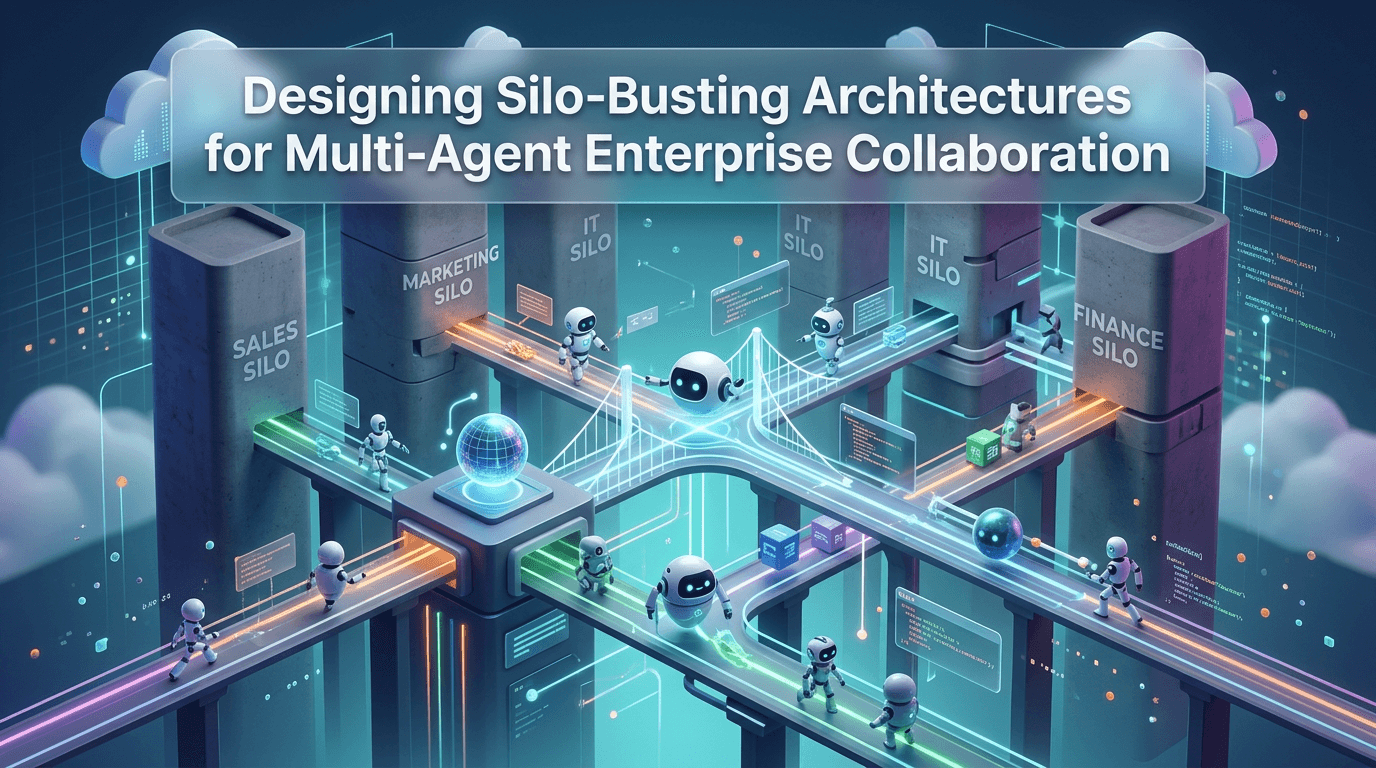
In today's rapidly evolving digital landscape, enterprises face a persistent challenge that undermines operational efficiency and innovation: organizational and technical silos. These silos create fragmented data ecosystems, impede cross-functional collaboration, and prevent businesses from fully leveraging their intellectual capital. As organizations increasingly adopt artificial intelligence and automation technologies, the need for cohesive multi-agent architectures has never been more critical.
Traditional enterprise systems were designed with monolithic architectures that naturally fostered separation between departments, processes, and data sources. While these systems served their purpose in earlier eras, they now represent significant barriers to the agility and intelligence that modern businesses require. Multi-agent systems offer a revolutionary approach to breaking down these barriers, enabling dynamic collaboration between autonomous entities that can share context, coordinate actions, and collectively solve complex problems.
Sapient Code Labs has been at the forefront of enterprise transformation, helping organizations design and implement architectures that transcend traditional boundaries. In this comprehensive guide, we explore the principles, patterns, and practices that define successful silo-busting architectures for multi-agent enterprise collaboration.
Silo-busting architecture represents a fundamental shift in how enterprises think about system design, data flow, and organizational structure. At its core, this approach emphasizes interconnectedness, interoperability, and shared context across all enterprise components. Rather than building isolated systems that serve narrow purposes, silo-busting architecture creates ecosystems where agents can seamlessly communicate, collaborate, and compound their individual capabilities.
The foundation of any silo-busting architecture rests on several key principles. First, shared context awareness ensures that all agents operate with a common understanding of enterprise state, goals, and constraints. Second, event-driven communication enables real-time information sharing without tight coupling between systems. Third, semantic interoperability allows diverse agents to understand and interpret data consistently, regardless of their origin or purpose.
These principles work together to create an environment where information flows naturally across organizational boundaries. When a customer service agent identifies an upselling opportunity, that insight immediately becomes available to sales, marketing, and product development agents. When a supply chain disruption occurs, all relevant stakeholders receive coordinated, contextually relevant alerts. This seamless information flow transforms isolated operations into a unified, intelligent enterprise.
Building effective multi-agent enterprise systems requires careful attention to architectural components that enable collaboration while maintaining appropriate boundaries. Understanding these components helps organizations design systems that are both powerful and manageable.
Agent Orchestration Layer serves as the central nervous system of multi-agent architectures. This layer manages agent lifecycle, coordinates complex workflows, and ensures consistent behavior across the system. Modern orchestration platforms provide sophisticated scheduling, priority management, and error recovery capabilities that allow organizations to deploy hundreds or thousands of specialized agents while maintaining operational coherence.
Knowledge Graph Infrastructure creates the semantic foundation that enables agents to understand relationships between enterprise entities. Unlike traditional databases that store discrete records, knowledge graphs capture the rich, interconnected nature of business information. This infrastructure allows agents to navigate complex relationship networks, infer hidden connections, and make contextually informed decisions based on holistic enterprise understanding.
Communication Fabric encompasses the protocols, message formats, and transport mechanisms that enable agent-to-agent interaction. Modern architectures typically combine synchronous APIs for real-time requests with asynchronous event streams for loose coupling and scalability. The communication fabric must support various interaction patterns including request-response, publish-subscribe, and conversation flows.
Security and Governance Framework addresses the unique challenges of multi-agent systems, where sensitive information traverses multiple boundaries. This framework encompasses authentication and authorization mechanisms, data privacy controls, audit logging, and compliance management. Effective governance ensures that collaboration enhances rather than compromises enterprise security posture.
Successful silo-busting architectures employ established design patterns that have proven effective across diverse enterprise contexts. These patterns provide reusable solutions to common challenges while maintaining architectural coherence.
The Federated Agent Pattern organizes agents into domain-specific clusters that maintain local autonomy while participating in broader enterprise workflows. Each federated group possesses specialized capabilities and contextual knowledge relevant to its domain, while coordination protocols enable cross-domain collaboration when needed. This pattern preserves the benefits of specialization while enabling enterprise-wide integration.
The Event Sourcing Pattern captures all enterprise state changes as immutable events that can be replayed, analyzed, and used to derive current state. This approach creates a complete audit trail, enables sophisticated analytics, and allows new agents to reconstruct context by processing historical events. Event sourcing naturally breaks down silos by making all state changes available to any authorized agent.
The Blackboard Pattern provides a shared knowledge repository where agents can post findings, query existing information, and collaborate on problem-solving without direct communication. This pattern proves particularly valuable for complex, multi-perspective analysis where diverse specialists must contribute their expertise to reach optimal solutions.
The Micro-Agent Architecture applies microservices principles to agent design, creating lightweight, focused agents that can be rapidly deployed, scaled, and composed into larger workflows. This approach enables organizations to build sophisticated capabilities from simple, reusable components while maintaining the agility to adapt to changing requirements.
Technical architecture alone cannot achieve true silo-busting without corresponding organizational transformation. Enterprises must address cultural, structural, and process-related factors that perpetuate silos even when technical barriers are removed.
Data governance becomes paramount in multi-agent environments where information flows freely across traditional boundaries. Organizations need clear policies about data ownership, quality standards, access controls, and usage guidelines. Effective governance frameworks balance collaboration benefits against privacy, compliance, and competitive sensitivity considerations.
Cross-functional teams should be established to design, implement, and maintain multi-agent systems. These teams bring together expertise from different organizational domains, ensuring that agent capabilities address genuine enterprise needs rather than narrow departmental interests. The collaborative team structure itself models the behavior expected from the agents they create.
Change management practices must address the human dimension of silo-busting. Employees may perceive multi-agent systems as threatening to their roles or expertise. Successful implementations include communication strategies that position agents as augmenting human capabilities rather than replacing them, along with training programs that help employees effectively collaborate with intelligent systems.
Implementing silo-busting architectures requires thoughtful planning and incremental execution. Organizations that attempt wholesale transformation often encounter resistance and technical challenges that derail their initiatives. A phased approach allows for learning, refinement, and gradual organizational adoption.
Begin with pilot programs that demonstrate value in contained contexts. Select high-visibility processes where multi-agent collaboration can deliver measurable improvements in efficiency, accuracy, or customer experience. These pilots generate organizational momentum and provide practical lessons that inform broader implementations.
Invest heavily in interoperability infrastructure that bridges existing systems. Most enterprises cannot replace their legacy systems entirely, so architecture must accommodate integration with existing databases, applications, and data sources. Modern integration platforms provide pre-built connectors and transformation capabilities that accelerate connectivity.
Establish observability mechanisms that provide visibility into agent behavior, decision-making, and collaboration patterns. As multi-agent systems grow in complexity, understanding their interactions becomes essential for debugging, optimization, and governance. Comprehensive logging, tracing, and analytics enable operators to maintain control over increasingly autonomous systems.
Implement feedback loops that allow agents to learn from outcomes and improve over time. Machine learning capabilities embedded within the architecture enable continuous refinement of agent behavior based on operational results. These feedback mechanisms transform static systems into evolving partners that grow more capable with experience.
The evolution of multi-agent enterprise systems continues rapidly, with emerging technologies promising even greater capabilities for silo-busting and collaboration. Organizations should monitor these developments to maintain competitive advantage and position themselves for future opportunities.
Large language models and generative AI are transforming agent capabilities, enabling more natural interaction between humans and agents, as well as more sophisticated reasoning within agent populations. These technologies allow agents to understand context more deeply, generate more nuanced responses, and handle situations that previously required human intervention.
Decentralized architectures based on blockchain and distributed ledger technologies offer new approaches to secure, transparent collaboration between agents representing different organizational stakeholders. These technologies enable trust establishment without centralized control, opening possibilities for cross-enterprise agent collaboration.
Edge computing and distributed processing enable agents to operate effectively in contexts where latency, connectivity, or data sovereignty concerns preclude cloud-centric approaches. This distributed capability allows enterprises to extend intelligent collaboration to manufacturing floors, remote locations, and other edge environments.
Designing silo-busting architectures for multi-agent enterprise collaboration represents both a technical challenge and an organizational opportunity. Success requires careful attention to architectural principles, component design, implementation patterns, and human factors. Organizations that master this integration position themselves to break through traditional boundaries and unlock new levels of operational efficiency, innovation, and competitive advantage.
The journey toward collaborative intelligence demands commitment, investment, and patience. However, the rewards extend far beyond operational improvements. Enterprises with effective multi-agent architectures develop adaptive capabilities that enable them to respond more quickly to market changes, anticipate customer needs more accurately, and capitalize on opportunities that siloed organizations simply cannot see.
Sapient Code Labs remains committed to helping organizations navigate this transformation, providing the expertise, technologies, and support needed to build enterprise systems that transcend traditional boundaries. The future belongs to organizations that embrace collaborative intelligence, and the architectural foundations laid today determine which enterprises will lead in 2026 and beyond.
Discover how to break down organizational silos with innovative multi-agent architectures that enable seamless enterprise collaboration and intelligent automation.
Silo-busting architecture is a design approach that breaks down organizational and technical barriers between different enterprise systems, departments, and data sources. It enables seamless information flow and collaboration across traditional boundaries through interconnected agents, shared context awareness, and event-driven communication patterns.
Multi-agent systems enable dynamic collaboration between autonomous intelligent entities that can share context, coordinate actions, and collectively solve complex problems. They transform isolated operations into unified systems where information flows naturally across organizational boundaries, improving efficiency, decision-making, and innovation.
Effective implementation requires a phased approach starting with pilot programs, investing in interoperability infrastructure, establishing cross-functional teams, and implementing robust governance frameworks. Organizations should begin with contained contexts that demonstrate value before scaling enterprise-wide.
Core components include the agent orchestration layer for workflow management, knowledge graph infrastructure for semantic understanding, communication fabric for agent interaction, and security/governance frameworks for compliance. These components work together to enable seamless collaboration while maintaining appropriate boundaries.
Benefits include breaking down data silos for better decision-making, enabling real-time cross-functional collaboration, improving operational efficiency through automated workflows, enhancing customer experiences with unified context, and creating adaptive capabilities for responding to market changes more quickly.
Work with us

