





Support center +91 97257 89197

Written by Pranav Begade
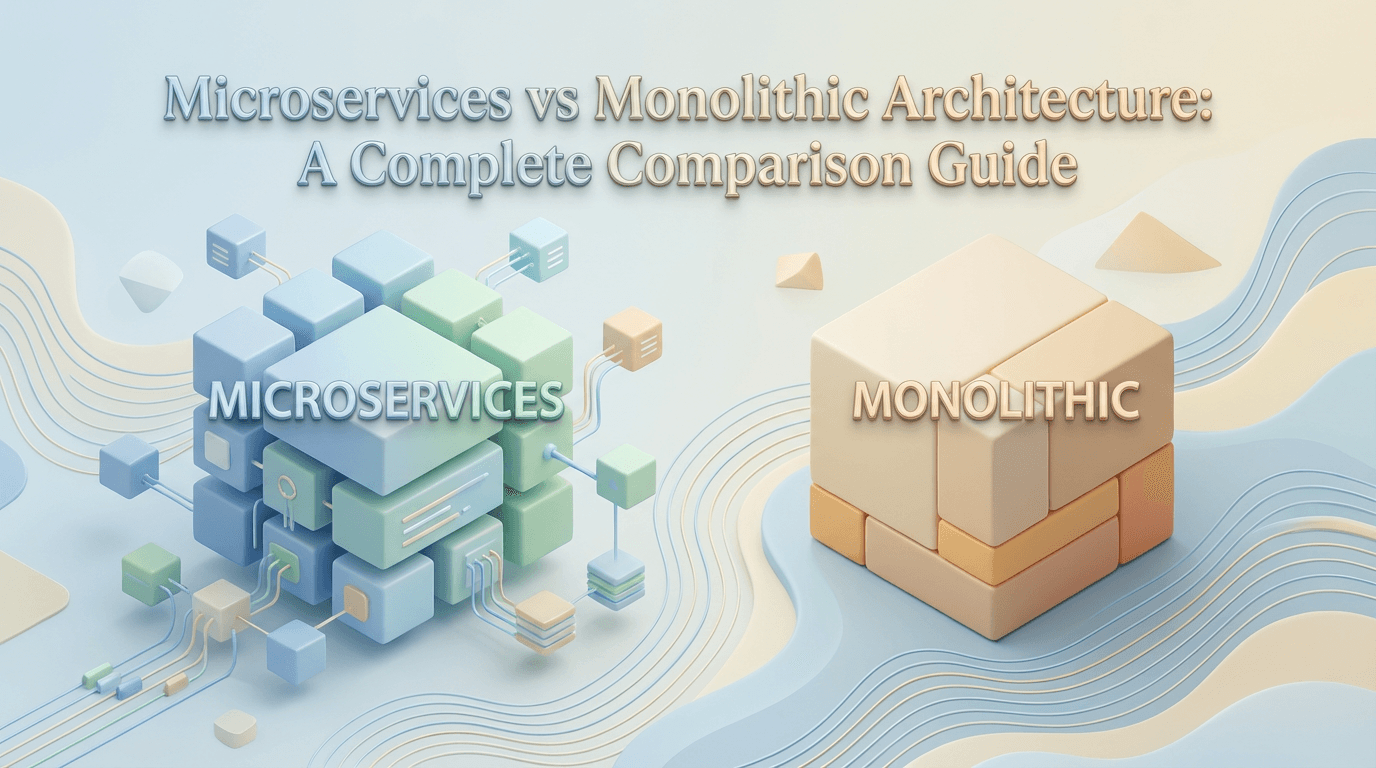
Choosing the right software architecture is one of the most critical decisions developers and business leaders face when building modern applications. The debate between microservices and monolithic architecture has become increasingly relevant as organizations strive to build scalable, maintainable, and efficient software systems. At Sapient Code Labs, we work with clients across various industries to help them make informed architectural decisions that align with their business goals and technical requirements.
In this comprehensive guide, we'll explore both architectural approaches, examining their strengths, weaknesses, and ideal use cases. Whether you're a startup building your first application or an enterprise modernizing legacy systems, understanding these architectural patterns will help you make better decisions for your projects.
Monolithic architecture is a traditional approach where an application is built as a single, unified unit. All components of the application—including the user interface, business logic, and data access layers—are combined into a single codebase that deploys as one unit. This architectural style has been the standard for software development for decades and remains popular for many types of applications.
In a monolithic architecture, all functionality resides in one deployable artifact. If you need to update a single function, you typically need to rebuild and redeploy the entire application. The database is usually centralized, with all modules accessing the same relational database. Communication between components happens through internal method calls rather than network protocols.
Monolithic applications are often developed using unified frameworks and technologies. For example, a Java application might use Spring Boot, while a .NET application might use ASP.NET Core. All developers work within the same codebase, sharing the same technology stack and development environment.
Microservices architecture represents a modern approach to software design where an application is decomposed into small, independent services. Each microservice is a self-contained unit that handles a specific business function and can be developed, deployed, and scaled independently. These services communicate with each other through well-defined APIs, typically using lightweight protocols like HTTP/REST or messaging queues.
The key principle behind microservices is the separation of concerns. Each service owns its data and business logic, maintaining its own database if necessary. This isolation allows teams to work on different services simultaneously without interfering with each other's work. Services can be written in different programming languages and use different data storage technologies based on their specific requirements.
Microservices architecture enables organizations to adopt modern development practices like continuous delivery, DevOps, and cloud-native deployment. Services can be containerized using Docker and orchestrated with Kubernetes, allowing for automatic scaling, fault isolation, and easy rollbacks when issues arise.
Understanding the fundamental differences between these architectural approaches is essential for making the right choice for your project. Let's examine the key distinctions across several dimensions.
In monolithic architecture, all code exists in a single repository and deploys as one unit. Any change, regardless of size, requires rebuilding and redeploying the entire application. Microservices, conversely, consist of multiple independent services, each with its own repository and deployment pipeline. Changes to one service don't affect others, enabling faster development cycles and more flexible deployment strategies.
Monolithic applications scale as a whole—you must scale the entire application even if only one component experiences high demand. Microservices allow for horizontal scaling of individual services based on their specific load requirements. If one service handles more traffic, you can deploy additional instances of just that service, optimizing resource utilization and cost efficiency.
Monolithic architectures typically require a single technology stack throughout the application. All components must use the same programming language, framework, and database. Microservices offer the flexibility to choose the best technology for each service. A compute-intensive service might use Go, while a service requiring rapid development might use Python or Node.js.
Monolithic applications often require coordinated development efforts, especially as the codebase grows. Multiple teams working on the same codebase can encounter merge conflicts and integration challenges. Microservices enable team autonomy, with each team responsible for their service's development, testing, and deployment. This autonomy can significantly improve developer productivity and satisfaction.
In monolithic applications, a failure in one component can bring down the entire application. Microservices provide natural fault isolation—a failure in one service doesn't necessarily affect others. Proper circuit breaker patterns and graceful degradation can help maintain overall system availability even when individual services fail.
Monolithic architecture offers several advantages that make it suitable for certain scenarios. Development simplicity is perhaps the most significant benefit—all code exists in one place, making it easier to understand, debug, and navigate. New developers can get up to speed more quickly when they only need to learn one codebase and deployment process.
Testing becomes more straightforward in monolithic applications. Since everything runs in a single process, you can write end-to-end tests that cover the entire application without dealing with network calls between services. Performance can also be better for certain workloads because communication happens through in-memory function calls rather than network protocols.
Deployment is simpler with monolithic applications. You only need to manage one artifact and one deployment pipeline. This simplicity reduces operational overhead and the potential for deployment-related errors.
As applications grow, monolithic architectures can become difficult to manage. The codebase can become complex and tightly coupled, making it challenging to understand the impact of changes. Large teams working on the same codebase may experience coordination difficulties and slower development cycles.
Technology lock-in is another concern. Once you've chosen your technology stack, migrating to different technologies becomes extremely difficult and risky. The entire application must be rewritten to adopt new frameworks or languages.
Scaling limitations can become problematic for high-traffic applications. You must scale the entire application even if only specific components need more resources, leading to inefficient use of infrastructure and increased costs.
Microservices architecture provides numerous benefits for modern application development. The ability to scale individual services independently allows for efficient resource utilization and cost optimization. You can allocate more resources to services that handle high traffic while keeping smaller resources for less demanding services.
Technology flexibility enables teams to choose the best tools for each job. Services can be written in different languages, use different databases, and leverage specialized frameworks optimized for their specific requirements. This flexibility allows organizations to adopt new technologies incrementally without requiring a complete system rewrite.
Faster development cycles become possible when teams can work independently. Each team can develop, test, and deploy their service on their schedule, without coordinating releases with other teams. This autonomy accelerates time-to-market for new features and updates.
Microservices architecture introduces complexity that requires sophisticated operational capabilities. Managing multiple services, each with its own deployment pipeline, requires robust DevOps practices and infrastructure. Organizations need expertise in containerization, orchestration, monitoring, and distributed systems.
Data consistency becomes more challenging when services maintain their own databases. Ensuring data integrity across services requires careful design of communication patterns and potentially implementing eventual consistency models. Transaction management across services is inherently complex.
Network latency and reliability issues arise when services communicate over a network. Unlike monolithic applications where calls happen in memory, microservices must handle network failures, timeouts, and retries. Designing resilient communication patterns with circuit breakers and proper error handling is essential.
Monolithic architecture remains an excellent choice for many scenarios, particularly for smaller applications and teams. If you're building a small to medium-sized application with a limited scope, the simplicity of monolithic architecture often outweighs the benefits of microservices. Startups and projects with uncertain requirements can benefit from the faster initial development that monolithic architecture enables.
Teams with limited DevOps experience should consider monolithic architecture. The operational complexity of microservices requires significant investment in infrastructure, monitoring, and automation. If your team is small or lacks experience with distributed systems, starting with a monolith and evolving later is often the pragmatic approach.
Applications with tight performance requirements where inter-service communication overhead is unacceptable may benefit from monolithic architecture. The in-memory communication of monoliths can provide lower latency for certain workloads.
The choice between microservices and monolithic architecture isn't about finding the universally superior option—it's about selecting the approach that best fits your specific circumstances. Both architectures have proven successful in various contexts, and many organizations have found success with either approach.
At Sapient Code Labs, we believe in starting simple and evolving as needed. For many projects, beginning with a well-structured monolithic application and gradually extracting services as requirements demand can be a pragmatic strategy. This approach allows you to validate your business logic and market fit while keeping complexity manageable.
However, for large-scale applications with complex requirements, distributed teams, or the need for independent scalability, microservices architecture provides significant advantages. The key is to make an informed decision based on your team's capabilities, your application's requirements, and your organizational goals.
Whether you're building a new application or modernizing an existing system, our experienced team at Sapient Code Labs can help you navigate these architectural decisions. We work closely with our clients to understand their unique challenges and recommend solutions that balance technical excellence with business value.
Discover the key differences between microservices and monolithic architecture to choose the right approach for your software development project.
The primary difference lies in how the application is structured and deployed. Monolithic architecture bundles all application components into a single deployable unit, while microservices architecture decomposes the application into independent services that can be deployed and scaled separately. Each approach has distinct implications for development, deployment, scaling, and maintenance.
Microservices are ideal when you need independent scalability, technology flexibility, team autonomy, and faster development cycles. If your application has multiple distinct functional domains, your team is large and distributed, or you anticipate significant growth in traffic or features, microservices provide the agility and scalability needed to meet those demands effectively.
Migration typically involves strangling the monolith—gradually identifying and extracting independent services while maintaining the existing system's functionality. Start by analyzing the codebase to identify domain boundaries, then extract the most independent and stable components first. Implement an API gateway to route requests between the monolith and new services, allowing for incremental migration over time.
Monolithic architecture offers simpler development and testing, easier debugging, straightforward deployment, and better performance for certain workloads. It's particularly well-suited for small teams, startups, and applications with simpler requirements. The unified codebase makes it easier for new developers to understand the entire system quickly.
Start by evaluating your project's specific requirements, including expected scale, team size, timeline, and technical complexity. Consider your team's expertise with distributed systems and DevOps practices. At Sapient Code Labs, we recommend assessing your current and anticipated needs, then choosing an architecture that provides the right balance of simplicity and flexibility for your situation. Many projects benefit from starting with a well-organized monolith and evolving toward microservices as needs grow.
Work with us

