HiMessiah · Social Networking Mobile App
Himessiah Church Community
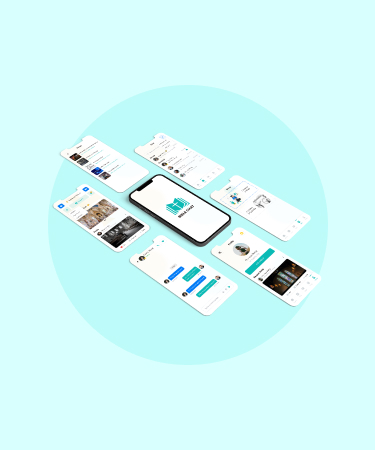
HiMessiah is a social networking app we built for church communities: members stay connected with their church, chat, share and worship together, and churchgoers can connect across different churches. It ships as native Android and iOS apps with an admin panel where churches and events are added, accounts are verified and reported content is moderated.
If you are researching church app development or planning to commission a church community app, the write-up below is the useful part. It covers how the product is structured, why moderation comes before features, what real-time video commits you to, how a bilingual Bible feature works, what it costs to scope, and when a church is better served without a custom app at all.
Strengthen your
faith with
Himessiah.
+ Frontend : Kotlin, Swift
+ Backend : Laravel (Php)
+ Database : MySQL
+ Hosting : AWS
+ 3rd party services : Agora.io, Bible API
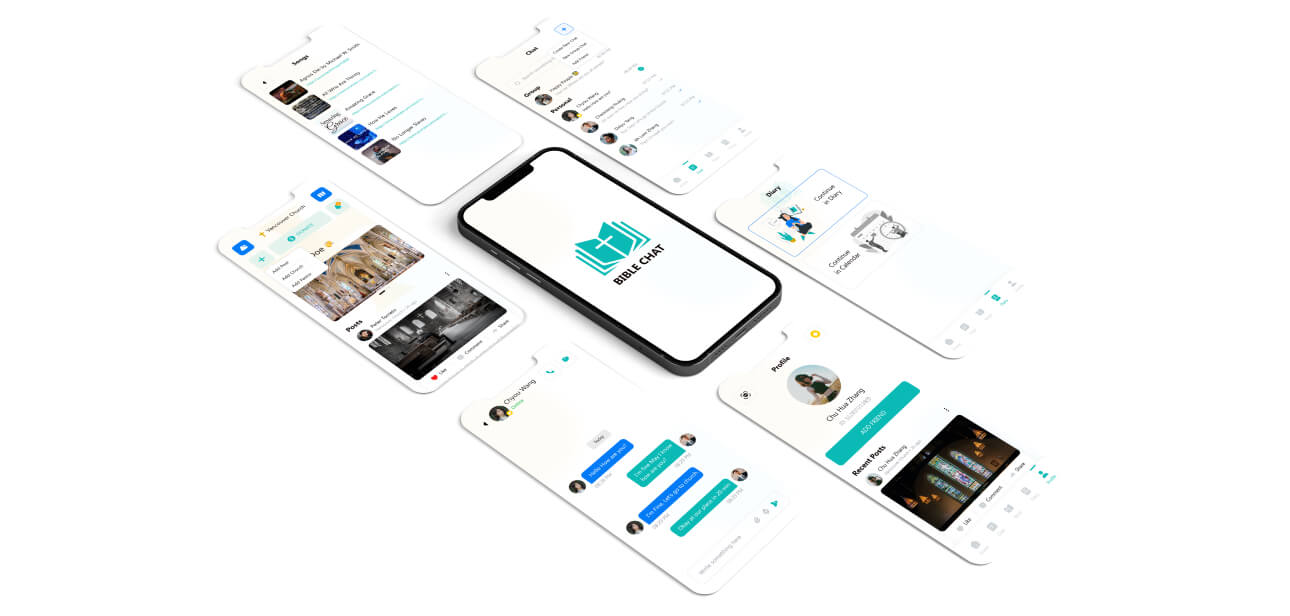
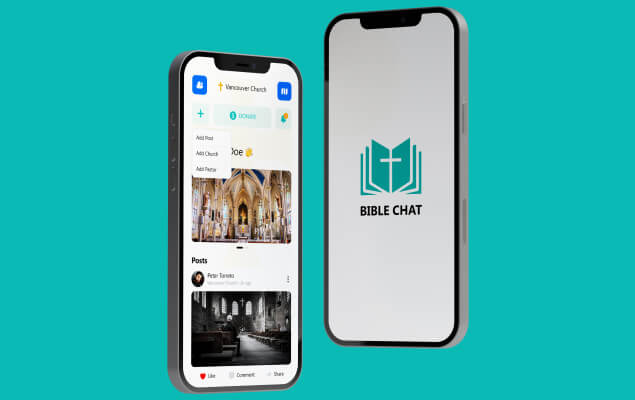
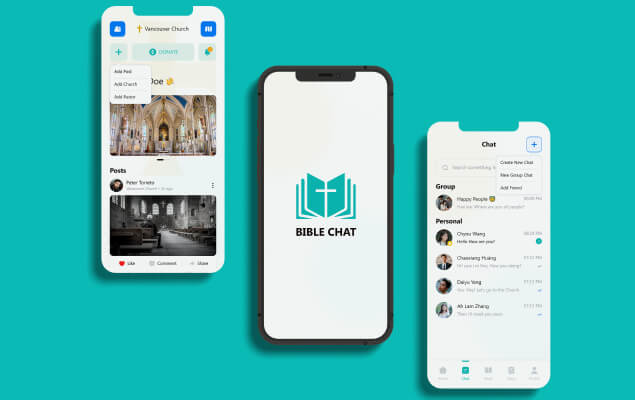
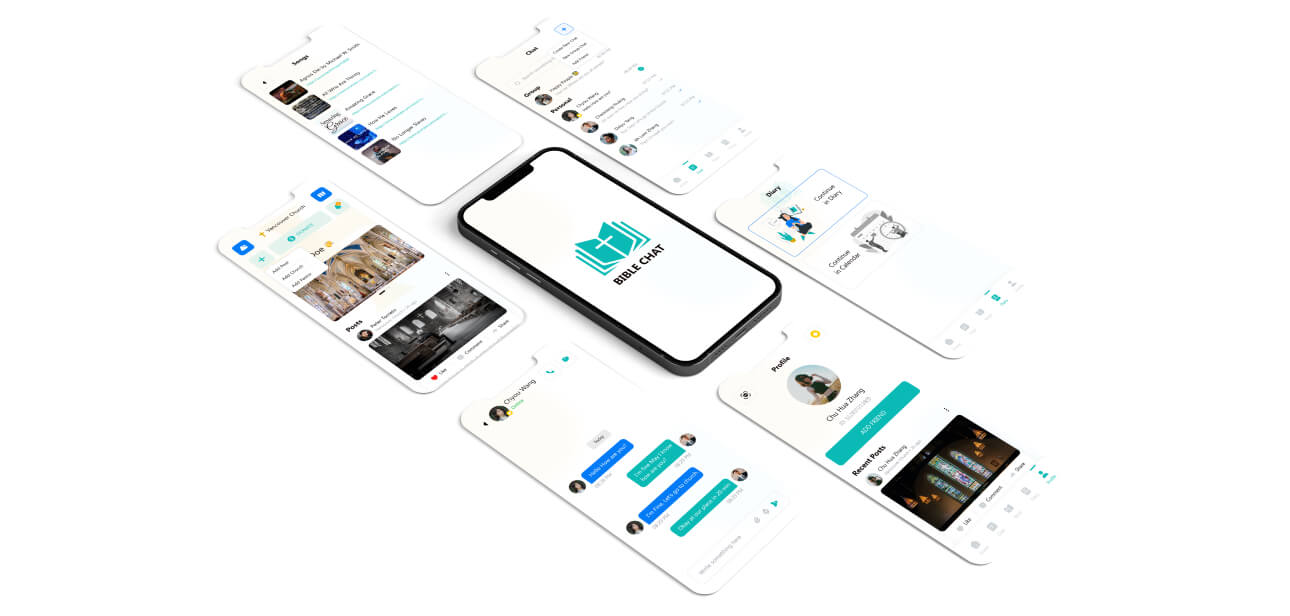
Mobile App
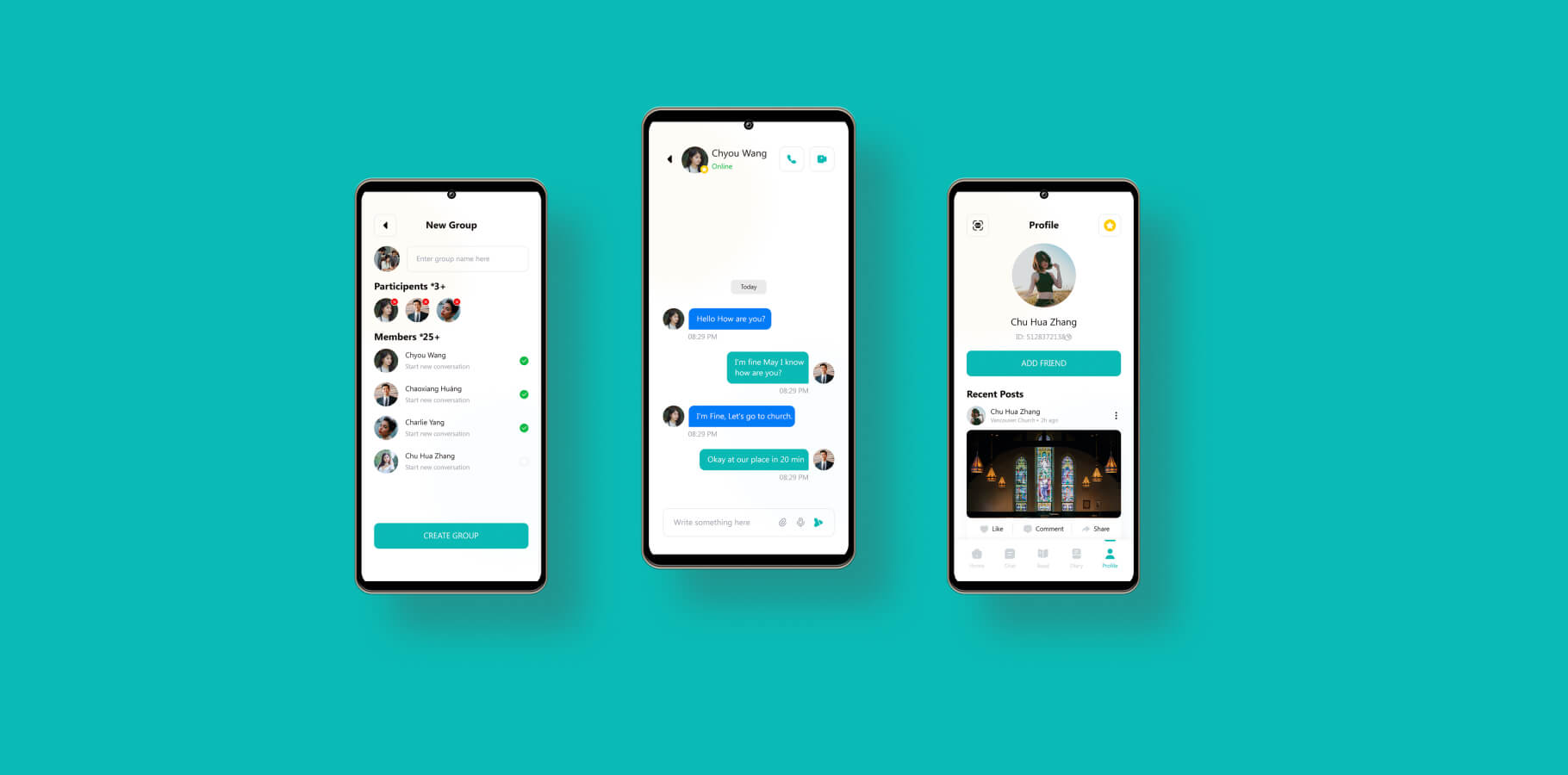
+ Chat and video call functionality for community members
+ Social media features such as photo and video sharing, liking and commenting on posts, and user profiles
+ Built-in Bible with bookmarking functionality
+ Church event listings and notifications
+ Multi-lingual support for English and Chinese languages
Admin Panel
+ Add and manage churches and events
+ View analytics and user activity on the platform
+ User management and account verification functionality
+ App settings and customization options
+ Content moderation and reporting system for inappropriate content.
A church community app is a small social network with churches as tenants
A church app is usually described as a feed plus a chat. Structurally it is a small social network where the church is the unit everything hangs off. In HiMessiah the admin panel adds and manages churches and their events. Churchgoers can also connect across churches, so the data model must answer a question most social apps never face: what stays inside one congregation, and what crosses the boundary.
That makes a church community app three products rather than one:
- The member app. Chat and video calls, a feed with photo and video posts, likes and comments, profiles, a Bible with bookmarks, and church events.
- The church layer. Which church a member belongs to, what that church publishes, and who is allowed to publish on its behalf.
- The admin panel. Adding churches and events, verifying accounts, managing users, reviewing reports, watching activity, and changing app settings.
Put the church identifier into the schema from the first migration. Adding it after launch means backfilling posts and events you cannot reliably attribute.
Moderation has to ship on day one, not after the first complaint
A faith community looks like a low-risk audience. It is not. The app mixes public posts, private chat and live calls, and its members include teenagers and people going through hard moments. One inappropriate post in a congregation's feed does more damage to trust than any crash.
The app stores take this seriously too. Apple and Google both expect apps with user-generated content to let people report objectionable content, block abusive users, and to show that someone acts on those reports.
HiMessiah includes a content moderation and reporting system in its admin panel, next to user management and account verification. If you are scoping something similar, the minimum set is:
- Report on every post, comment, profile and conversation, with a reason attached.
- Block, so a member can stop contact immediately without waiting for a moderator.
- A review queue where a moderator sees the reported item in context and can remove it, warn the author or suspend the account.
- Verification before an account can post or call, so a suspended user cannot sign up again in a minute.
Decide early who moderates. A central team, each church's own leaders, or both are workable, and each needs different permissions in the admin panel.
Real-time chat and video: buy the transport, own everything around it
HiMessiah uses Agora.io for its real-time chat and video calls. For most community apps, buying is the sensible default.
The alternative is building on WebRTC, which is free as a standard but not as a system. One-to-one calls need signalling and TURN servers for people behind restrictive networks. Group calls need a media server to route streams, which is infrastructure you then keep running. A managed provider hands you that layer and bills by usage.
Either way, several things stay yours:
- Presence. Who is online, and what happens when a call rings on a sleeping phone.
- Notifications. Incoming call and message alerts travel through Apple and Google push services, not the video SDK, and each platform has its own rules for call-style alerts.
- Abuse. A provider moves audio and video. It does not know who should be allowed to call whom. Blocking and reporting have to reach into calls and chat, not only the feed.
- Cost that scales with minutes. Usage pricing is cheap at launch and grows with engagement. Model the bill at the activity you hope for, not the activity you start with.
The Bible is licensed content, and a second language doubles the work
A built-in Bible sounds like a text file. It is licensed content. Many modern translations are under copyright and their publishers control how the text is distributed, so the usual pattern is to fetch it through a Bible API rather than bundle it in the app. HiMessiah takes that route, with a Bible API behind its built-in reader and bookmarking.
- Bookmarks belong to the user, not the device. Store them on the backend against a book, chapter and verse reference so they survive a new phone.
- Cache only what the licence allows. Check the API terms before storing chapters offline.
- Keep references independent of translation. A bookmark saved while reading in one language should open the same verse in the other.
HiMessiah supports English and Chinese, and a second language reaches well past the menus. Interface strings need a translation workflow, and screens designed around English labels need testing in Chinese, where line length and layout change. Rely on the system's Chinese fonts rather than bundling a custom typeface, which for Chinese runs to many megabytes. The Bible text becomes a separate content source per language. And whoever reviews reported posts has to read both languages.
Events and notifications decide whether people keep the app installed
HiMessiah includes church event listings and notifications. Notifications are how members hear about events, and also how community apps get muted and then deleted.
The pattern is predictable. Every leader wants their announcement pushed. Every group chat alerts on every message. Within a month the member has switched notifications off in the phone's settings, and once that happens the app cannot switch them back on.
- Separate the channels. Event reminders, direct messages, calls and feed activity each get their own setting.
- Batch the noisy ones. Likes and comments can wait for a daily summary. Calls and direct messages cannot.
- Make broadcasting a permission. A push to a whole church should not be available to anyone who creates an event.
- Remind at useful times. The evening before and shortly before the start is enough for most events.
Native Kotlin and Swift, or one cross-platform codebase
HiMessiah is built as two native apps, Kotlin on Android and Swift on iOS, on a Laravel and MySQL backend hosted on AWS. The alternative is a cross-platform framework such as Flutter or React Native, with one codebase for both phones. Neither is right in the abstract.
| Native (Kotlin plus Swift) | Cross-platform (one codebase) | |
|---|---|---|
| Codebases | Two, usually two sets of skills | One, with native code where needed |
| Build and maintenance effort | Most features are built twice | Most features are built once |
| Calls, push and background work | Direct access to each platform's behaviour | Works, through plugins or bridges you may need to debug |
| New OS features | Available as soon as the platform ships them | Available once the framework or a plugin supports them |
| Feature parity | Android and iOS can drift apart | Parity is the default |
For an app whose core is live video, call alerts and background behaviour, native removes a layer between you and the parts most likely to misbehave. For an app that is mostly feeds and events, one codebase is usually the better use of budget. Agora and the major push services offer SDKs for native and for the common cross-platform frameworks, so the video decision does not force the platform decision.
What it costs, and how to scope it
There is no honest single price for a church community app, but there is a method. Our published blended rate is about $20 per hour for a senior team, so cost is hours, and hours come from team size and duration. As illustrative arithmetic only, not a quote: two developers for ten weeks at 40 hours a week is 800 hours, about $16,000. A team of four for sixteen weeks is 2,560 hours, about $51,200. Building two native apps instead of one shared codebase adds most of the mobile effort a second time. The mobile app development cost guide breaks the pieces down feature by feature.
The cheapest first release cuts features, not safety. An MVP-sized first version might be one language, a feed, chat and events, with reporting and blocking from day one. Video calling can follow once members are using the app. To turn that into a fixed number, the Scoping Sprint below is credited in full if we build it.
When a church should not build an app
Most churches do not need a custom app. If what you need is announcements, a service schedule, sign-ups and online giving, existing church management software and ordinary group chat tools already cover it, and they work tomorrow. An empty custom feed is worse than no app.
A custom build makes sense when the community itself is the product: a network spanning several churches, features the ready-made tools do not offer, a language mix they handle badly, or control over data and moderation that a shared platform will not give you. If that describes your plan, it is mobile application development, and it is work we have shipped.
Planning a community app for a church or a network of churches? A Scoping Sprint ($2,300, two weeks) ends with the member app, admin panel and moderation flow mapped out for your case, a prototype, and a fixed quote. Or just start a conversation.