





Support center +91 97257 89197

Written by Pranav Begade
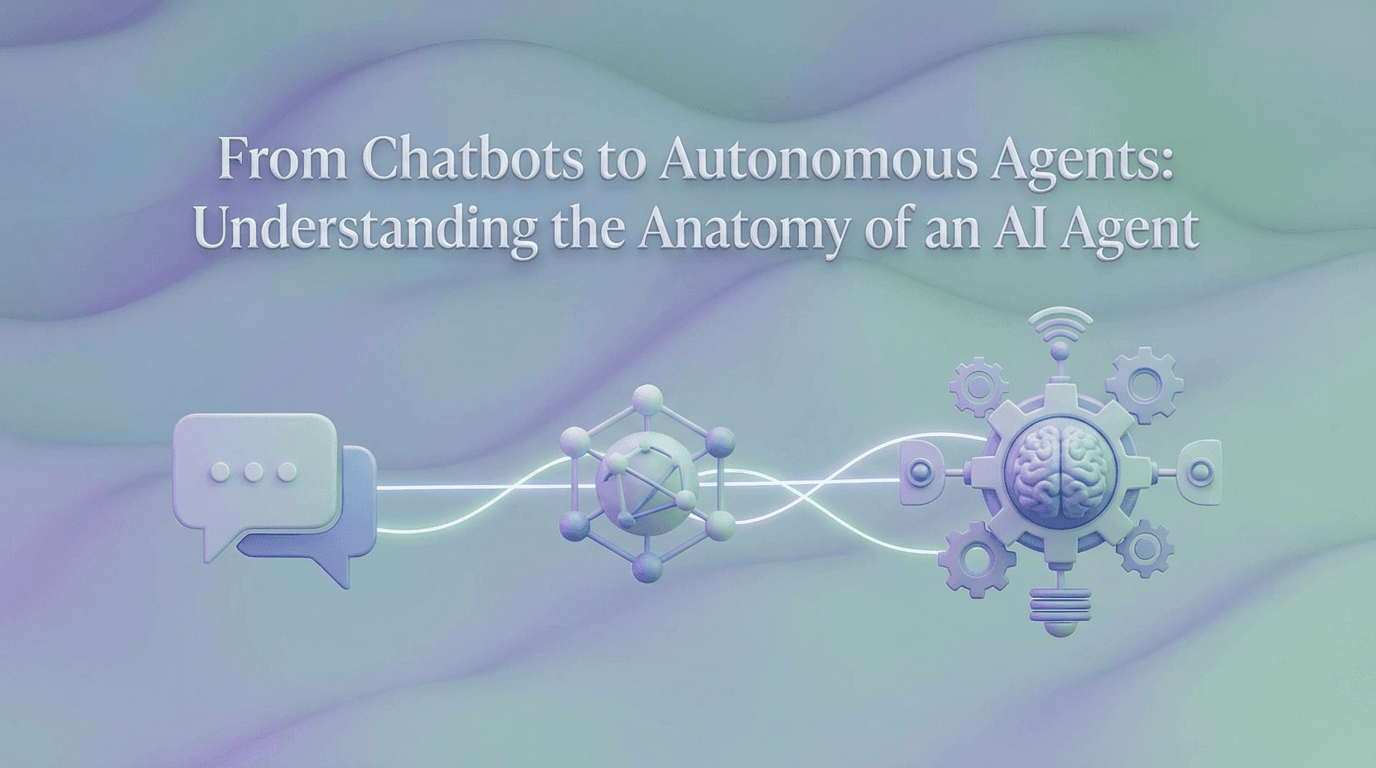
The landscape of artificial intelligence has undergone a remarkable transformation over the past decade. What began as simple rule-based chatbots that could respond to basic queries has evolved into sophisticated autonomous agents capable of reasoning, planning, and executing complex tasks with minimal human intervention. This evolution represents not just a technological advancement, but a fundamental shift in how businesses leverage AI to drive innovation and efficiency.
At Sapient Code Labs, we have witnessed this transformation firsthand through our work in AI integration and development. Our team has helped numerous organizations navigate this transition, moving from conventional chatbot implementations to truly intelligent agentic systems. Understanding the anatomy of an AI agent has become essential for businesses looking to stay competitive in an increasingly AI-driven world.
To understand the anatomy of an AI agent, we must first establish what differentiates it from traditional chatbot technology. While chatbots and AI agents might appear similar on the surface, their underlying capabilities and operational approaches differ significantly.
Chatbots are typically designed to respond to user inputs based on predefined rules or simple machine learning models. They operate within strict boundaries, following decision trees and providing responses from a limited knowledge base. Their interaction model is largely reactive—they wait for user input and respond accordingly.
AI agents, on the other hand, operate on a fundamentally different paradigm. They are designed to perceive their environment, reason about complex situations, plan their actions, and execute tasks autonomously. Rather than simply responding to queries, AI agents can take initiative, make decisions, and adapt their behavior based on changing circumstances. They combine large language models with planning capabilities, memory systems, and tool-use functionalities to accomplish goals that extend far beyond simple question-and-answer exchanges.
The architecture of an AI agent comprises several interconnected components that work together to enable autonomous behavior. Understanding these components is crucial for anyone looking to implement or develop AI agent systems.
At the heart of most modern AI agents lies a large language model (LLM) that serves as the reasoning engine. This core component processes natural language, understands context, and generates human-like responses. The LLM provides the fundamental capability to comprehend complex instructions, engage in meaningful dialogues, and apply logical reasoning to problem-solving.
The quality and capabilities of the underlying LLM significantly influence the agent's performance. Different models offer varying levels of reasoning, domain knowledge, and generation quality. At Sapient Code Labs, we carefully evaluate LLM options based on specific use case requirements, considering factors such as accuracy, response speed, and cost-effectiveness.
What separates autonomous agents from simple chatbots is their ability to plan and reason. The planning module enables the agent to break down complex goals into manageable steps, sequence those steps logically, and adapt the plan when obstacles arise.
This component employs various reasoning techniques, including chain-of-thought reasoning, which allows the agent to work through complex problems step by step. The agent can evaluate different approaches, anticipate potential challenges, and select optimal paths toward goal achievement. This planning capability is what enables AI agents to handle multi-step workflows that would be impossible for traditional chatbot systems.
An effective AI agent must maintain context across interactions and accumulate knowledge over time. This is achieved through sophisticated memory systems that come in several forms. Short-term memory allows the agent to maintain context within a single conversation or task session. Long-term memory enables the agent to retain information learned across multiple interactions, building a knowledge base that improves over time.
Some advanced agents also incorporate episodic memory, which stores specific experiences and outcomes that can inform future decision-making. This memory architecture allows AI agents to provide more personalized and contextually relevant responses, learning from past interactions to improve their performance continuously.
True autonomy requires the ability to interact with external systems and execute real-world actions. AI agents are equipped with tool-use capabilities that allow them to interface with APIs, databases, software applications, and other digital systems. This integration capability transforms AI agents from passive conversational systems into active participants in business processes.
For example, an AI agent in a customer service context might not only respond to inquiries but also access customer databases, update records, process transactions, and trigger automated workflows. This tool-use functionality is achieved through carefully designed function calling mechanisms that allow the agent to invoke external services securely and reliably.
Modern AI agents often operate within orchestration frameworks that manage their behavior, handle errors, and ensure consistent performance. These frameworks provide the structural foundation that coordinates all other components, ensuring they work together harmoniously.
The orchestration layer handles task routing, manages the flow of information between components, implements safety guardrails, and monitors performance. It essentially serves as the operating system for the AI agent, enabling reliable and predictable behavior across diverse scenarios.
Understanding how AI agents work involves examining the operational cycle that enables their autonomous behavior. This cycle typically involves several key phases that repeat throughout the agent's operation.
The process begins with perception, where the agent gathers information from its environment through various inputs. This might include user messages, data from integrated systems, or environmental signals. The agent then engages in reasoning, analyzing the gathered information, considering relevant context, and determining appropriate courses of action.
Following reasoning, the agent enters the planning phase, where it develops a strategy for achieving its goals. This involves breaking down complex objectives into actionable steps and determining the sequence in which those steps should be executed. The agent then takes action, invoking necessary tools, making decisions, and executing planned tasks.
Throughout this cycle, the agent continuously evaluates its progress, learning from outcomes and adjusting its approach as needed. This feedback loop enables the agent to improve its performance over time, becoming more effective at handling complex situations.
The AI agent landscape encompasses various agent types, each designed for specific operational contexts and complexity levels. Understanding these different types helps organizations select the appropriate approach for their needs.
Simple reflex agents operate based on condition-action rules, responding to immediate inputs without considering broader context. While limited in capability, they excel at handling straightforward, repetitive tasks efficiently.
Model-based agents maintain an internal representation of their environment, enabling them to handle more complex scenarios by understanding how their actions affect the world around them.
Goal-based agents are designed to achieve specific objectives, employing planning algorithms to determine the optimal sequence of actions needed to reach desired outcomes. These agents are particularly valuable for business applications requiring achievement of defined goals.
Utility-based agents go beyond simple goal achievement by evaluating different approaches based on utility functions that quantify the desirability of various outcomes. This enables them to make sophisticated trade-offs and select optimal strategies.
Learning agents represent the most advanced category, capable of improving their performance over time through experience. These agents can adapt their behavior based on feedback, learning from both successes and failures to enhance their effectiveness.
The practical applications of AI agents extend across virtually every industry and business function. Organizations implementing AI agents can achieve significant improvements in efficiency, accuracy, and customer satisfaction.
In customer service, AI agents handle complex inquiries that go beyond simple FAQ responses. They can access customer history, process requests, resolve issues, and escalate situations appropriately—all while maintaining natural, engaging conversations. This reduces the burden on human support teams while improving response times and customer experience.
In operations and logistics, AI agents coordinate complex workflows, manage supply chains, optimize resource allocation, and predict maintenance needs. Their ability to process vast amounts of data and make informed decisions enables organizations to operate more efficiently and respond more quickly to changing conditions.
In software development, AI agents assist with code generation, testing, debugging, and documentation. They can understand codebase context, suggest improvements, and even implement changes autonomously. At Sapient Code Labs, we leverage these capabilities to accelerate development cycles while maintaining code quality.
In data analysis and business intelligence, AI agents gather information from multiple sources, identify patterns, generate insights, and present recommendations. This enables more informed decision-making across the organization.
Organizations embarking on AI agent implementation must carefully consider several factors to ensure successful deployment. Security and data privacy represent paramount concerns, as AI agents often handle sensitive information and access critical systems. Robust authentication, authorization, and data protection measures must be implemented throughout the agent architecture.
Governance and oversight mechanisms are essential for ensuring AI agents operate within appropriate boundaries. This includes defining clear policies for agent behavior, implementing monitoring systems to track performance, and establishing processes for human review of significant decisions.
Integration complexity varies depending on existing systems and infrastructure. Organizations must plan for proper integration with current applications, databases, and workflows to maximize the value delivered by AI agents.
Continuous evaluation and improvement processes help ensure AI agents remain effective as requirements evolve. Regular assessment of agent performance, user feedback integration, and model updates contribute to long-term success.
Looking ahead, AI agents will continue to evolve in sophistication and capability. Advances in reasoning, multimodal understanding, and tool use will enable agents to handle increasingly complex tasks with greater autonomy.
We can expect AI agents to become more deeply integrated into business operations, taking on more substantial roles in decision-making and process execution. The boundary between human and AI collaboration will continue to blur, with agents becoming trusted partners in achieving organizational objectives.
At Sapient Code Labs, we remain committed to staying at the forefront of these developments, helping our clients leverage AI agent technology to drive innovation and competitive advantage. The journey from chatbots to autonomous agents represents just the beginning of a transformative era in artificial intelligence.
The transformation from simple chatbots to sophisticated autonomous agents represents one of the most significant developments in artificial intelligence. Understanding the anatomy of an AI agent—its core components, operational mechanisms, and practical applications—provides the foundation for successful implementation and deployment.
AI agents combine large language models with planning capabilities, memory systems, and tool-use functionalities to achieve a new level of autonomous behavior. This enables organizations to automate complex workflows, enhance customer experiences, and drive operational efficiency in ways that were previously impossible.
As AI technology continues to advance, the capabilities and applications of autonomous agents will expand even further. Organizations that understand and embrace this technology today will be better positioned to thrive in the AI-driven future. Whether you are exploring AI agent implementation or seeking to enhance existing capabilities, the team at Sapient Code Labs has the expertise to guide your journey.
Explore the evolution from simple chatbots to sophisticated autonomous AI agents. Learn about the components, architecture, and business applications.
Chatbots are rule-based systems that respond to specific inputs using predefined responses, operating within strict boundaries. AI agents, conversely, can perceive their environment, reason about complex situations, plan actions, and execute tasks autonomously. While chatbots react to queries, agents take initiative, adapt to changing circumstances, and handle multi-step workflows that extend beyond simple question-and-answer interactions.
An AI agent architecture typically includes five key components: a large language model core for reasoning and language processing; a planning and reasoning module for breaking down complex goals; memory systems for maintaining context across interactions; tool-use capabilities for interfacing with external systems; and an orchestration framework that coordinates all components, manages behavior, and ensures consistent performance.
Autonomous agents handle complex workflows through a cycle of perception, reasoning, planning, and action. They gather information from their environment, analyze it with consideration for context, develop strategies by breaking goals into actionable steps, execute those steps using integrated tools, and continuously evaluate their progress. This enables them to manage multi-step processes, adapt to obstacles, and learn from outcomes to improve future performance.
AI agents deliver numerous business benefits including enhanced efficiency through automation of complex tasks, improved customer experience with faster and more accurate responses, better decision-making through data-driven insights, reduced operational costs by handling routine operations autonomously, and scalability that allows businesses to handle increased workload without proportional resource expansion. They also free human employees to focus on higher-value strategic activities.
To get started with AI agent implementation, begin by identifying specific business processes that would benefit from automation and enhanced decision-making. Assess your existing technology infrastructure and data accessibility. Partner with an experienced AI development company like Sapient Code Labs that can evaluate your requirements, design appropriate agent architecture, and ensure proper integration with your systems. Start with a pilot project to demonstrate value before scaling to broader implementation.
Work with us

