





Support center +91 97257 89197

Written by Pranav Begade
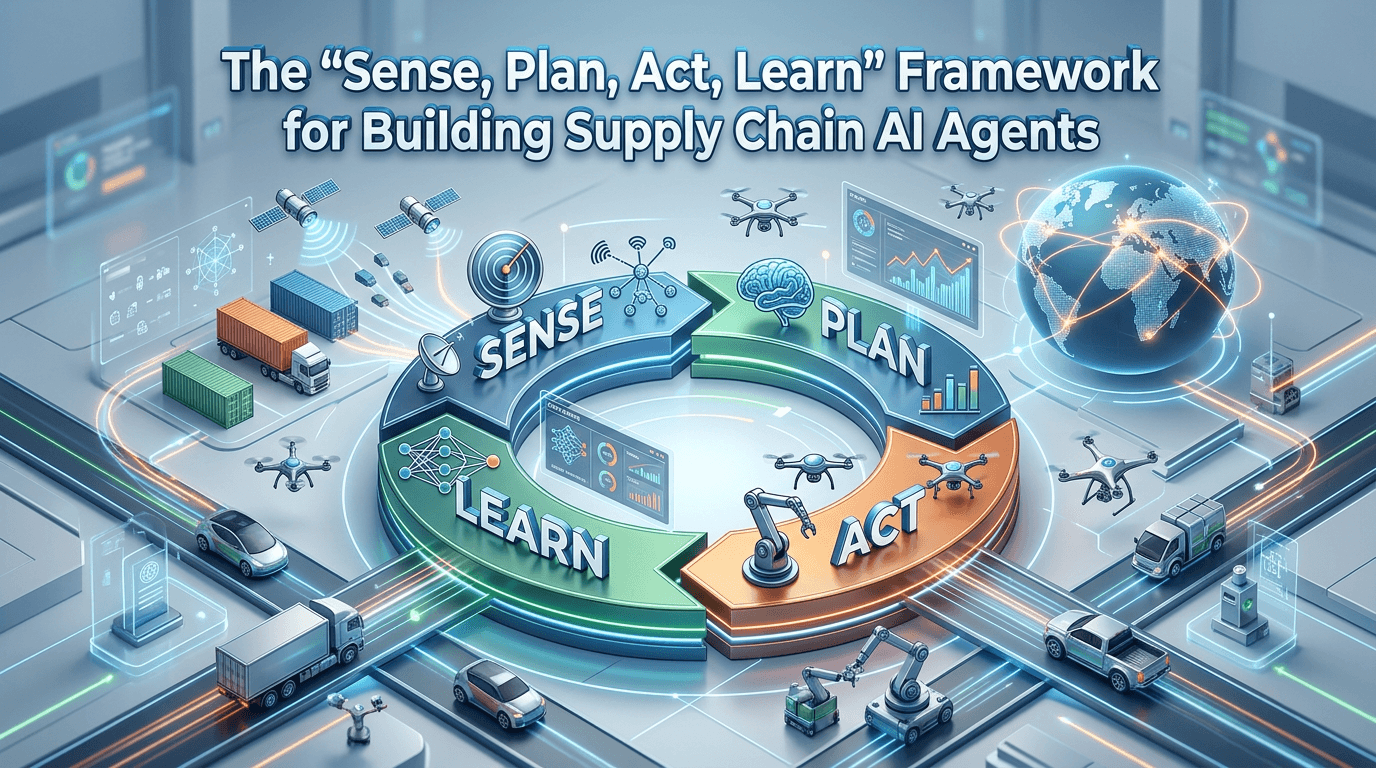
The modern supply chain faces unprecedented complexity. Global disruptions, volatile demand patterns, and intricate logistics networks have exposed the limitations of traditional, rule-based systems. Organizations are increasingly turning to artificial intelligence to create autonomous agents capable of navigating this complexity with minimal human intervention.
At Sapient Code Labs, we've developed and refined a cognitive architecture that serves as the foundation for building sophisticated supply chain AI agents: the Sense, Plan, Act, Learn (SPAL) framework. This architectural pattern draws from decades of research in robotics, cognitive science, and autonomous systems, adapted specifically for the unique challenges of supply chain management.
In this comprehensive guide, we'll explore how this framework enables the creation of AI agents that can perceive their environment, reason about complex decisions, execute actions autonomously, and continuously improve over time.
The SPAL framework represents a cognitive architecture—a structured approach to designing AI systems that can operate autonomously in dynamic environments. Each component plays a distinct role in enabling intelligent behavior:
Sense involves collecting and processing data from multiple sources to build a comprehensive understanding of the current state. In supply chain contexts, this means aggregating data from ERP systems, IoT sensors, market feeds, transportation networks, and customer systems.
Plan encompasses the reasoning and decision-making processes that determine optimal courses of action. This includes demand forecasting, inventory optimization, route planning, and scenario analysis.
Act covers the execution layer—translating decisions into concrete actions and interfacing with existing systems to implement changes across the supply chain.
Learn enables continuous improvement by analyzing outcomes, identifying patterns, and refining models and strategies based on real-world feedback.
What makes this framework particularly powerful for supply chain applications is its cyclical nature. The output of one phase becomes input for the next, with feedback loops that enable learning and adaptation over time.
Effective AI agents require comprehensive, real-time awareness of their operating environment. The Sense phase addresses this through multi-source data integration and intelligent processing.
Modern supply chains generate vast amounts of data from diverse sources. ERP systems like SAP, Oracle, and Microsoft Dynamics provide transactional data on orders, inventory, and financials. IoT sensors track shipments, monitor storage conditions, and capture equipment performance metrics. Weather services, traffic systems, and market data feeds provide external factors that impact supply chain operations.
The challenge lies not just in collecting this data, but in synthesizing it into a coherent representation. Our framework employs several key techniques:
Data Fusion combines information from multiple sources to create a unified view. This involves reconciling different data formats, resolving temporal discrepancies, and handling missing or inconsistent data points.
Event Processing identifies meaningful events and patterns in real-time streams. This includes detecting demand spikes, identifying supply disruptions, recognizing quality issues, and flagging anomalies that require attention.
State Estimation maintains an accurate representation of current conditions across the entire supply chain network. This involves tracking inventory levels, production status, transportation progress, and customer demand in near real-time.
Advanced implementations incorporate predictive elements, using historical patterns and current indicators to estimate future states. This predictive awareness enables proactive decision-making rather than merely reactive responses.
Once an AI agent has sensed its environment, it must determine the best course of action. The Plan phase encompasses the reasoning capabilities that distinguish truly intelligent systems from simple automation.
Supply chain planning involves multiple time horizons and decision types:
Strategic Planning addresses long-term decisions including network design, supplier selection, and capacity investment. These decisions typically involve significant capital commitment and multi-year implications.
Tactical Planning focuses on medium-term optimization—inventory policies, production schedules, transportation modes, and workforce planning. These decisions balance cost efficiency with service level requirements.
Operational Planning handles day-to-day execution—order allocation, route optimization, inventory replenishment, and exception handling. These decisions require rapid response to changing conditions.
AI agents powered by the SPAL framework employ multiple planning techniques depending on the decision type:
Optimization Algorithms solve well-defined mathematical problems, finding optimal or near-optimal solutions for complex planning scenarios. This includes linear programming for network flow problems, mixed-integer programming for facility location, and dynamic programming for sequential decisions.
Machine Learning Models handle prediction tasks—demand forecasting, lead time estimation, and risk assessment. Modern approaches combine statistical models with deep learning for improved accuracy.
Reinforcement Learning enables agents to learn optimal policies through experience. This proves particularly valuable for sequential decisions where the consequences of actions unfold over time.
Multi-Agent Coordination addresses scenarios where multiple AI agents must collaborate or compete. This is relevant for complex supply networks where different organizational units or external partners operate semi-autonomously.
Planning without execution produces no value. The Act phase translates decisions into actions and interfaces with existing systems to implement changes across the supply chain.
Execution in supply chain contexts typically involves integration with several system categories:
Enterprise Systems including ERP, WMS, and TMS platforms. AI agents must communicate with these systems to create purchase orders, initiate shipments, adjust inventory, and update production plans.
Trading Partner Systems including supplier portals, customer platforms, and logistics provider interfaces. This enables collaboration with external stakeholders while maintaining appropriate data sharing and security boundaries.
Physical Systems including warehouse automation, transportation management, and manufacturing control systems. The integration with physical systems enables direct control of equipment and processes.
Effective execution requires robust error handling and exception management. AI agents must recognize when automated execution fails, understand why failures occurred, and determine appropriate responses—retrying, escalating to human operators, or adjusting plans based on new information.
The Act phase also encompasses human-in-the-loop scenarios where AI recommendations require human approval before execution. Well-designed systems provide clear explanations, relevant context, and intuitive approval workflows to enable efficient human-AI collaboration.
The final phase distinguishes advanced AI agents from traditional automation: the ability to learn from experience and improve over time.
Learning in supply chain contexts occurs at multiple levels:
Model Refinement involves updating predictive models based on observed outcomes. This includes retraining demand forecasting models with actual sales data, adjusting lead time estimates based on delivery performance, and refining risk models based on disruption events.
Policy Optimization involves improving decision policies based on outcomes. Reinforcement learning approaches excel here, enabling agents to discover strategies that outperform initial designs.
Pattern Recognition involves identifying recurring situations and effective responses. This enables faster recognition of familiar scenarios and more effective handling of novel situations.
Anomaly Detection involves identifying unusual patterns that may indicate emerging issues or opportunities. Effective anomaly detection enables proactive response to events before they impact operations.
Learning requires careful attention to data quality, feedback loops, and evaluation metrics. Organizations must establish processes for collecting outcome data, evaluating model performance, and deploying updated models without disrupting operations.
Building supply chain AI agents using the SPAL framework requires thoughtful implementation across several dimensions:
Data Infrastructure serves as the foundation. Organizations need robust data pipelines that can collect, clean, and integrate data from diverse sources in near real-time. Modern data architectures including data lakes, streaming platforms, and feature stores support these requirements.
Integration Capabilities enable AI agents to interact with existing systems. API-based architectures, event-driven integration patterns, and robotic process automation provide flexibility for different integration scenarios.
Governance Frameworks address risk management, compliance, and accountability. Organizations must establish clear guidelines for AI decision-making authority, human oversight requirements, and audit trails.
Change Management ensures successful adoption. Stakeholder buy-in, training programs, and phased rollout strategies help organizations realize the benefits of AI-powered automation while managing organizational transition.
Starting with well-defined use cases that demonstrate clear value helps build organizational confidence and capability. Common starting points include demand sensing, inventory optimization, and transportation execution—areas where AI can deliver measurable improvements while building organizational experience.
Organizations across industries are applying the SPAL framework to transform supply chain operations:
Retail and E-commerce companies use AI agents for dynamic inventory allocation, predictive fulfillment, and demand-responsive replenishment. These agents sense customer behavior patterns, plan optimal inventory distribution, act to fulfill orders from optimal locations, and learn from customer satisfaction metrics.
Manufacturing organizations employ AI agents for production scheduling, quality control, and predictive maintenance. These agents sense equipment performance and quality metrics, plan production schedules that balance efficiency with responsiveness, act to adjust machine parameters and production sequences, and learn from quality outcomes and equipment failures.
Logistics providers leverage AI agents for route optimization, load planning, and exception management. These agents sense real-time traffic, weather, and shipment conditions, plan optimal routes and loading configurations, act to dispatch instructions and coordinate with drivers, and learn from delivery outcomes and customer feedback.
The Sense, Plan, Act, Learn framework provides a structured approach to building AI agents capable of autonomous operation in complex supply chain environments. By combining robust environmental awareness, sophisticated decision-making, reliable execution, and continuous learning, organizations can create AI systems that deliver lasting competitive advantage.
As AI capabilities continue to advance, we can expect supply chain agents to handle increasingly complex decisions with greater autonomy. The framework's modular nature allows organizations to start with focused applications and progressively expand capabilities as they build experience and confidence.
At Sapient Code Labs, we're committed to helping organizations navigate this transformation. Our expertise in AI development, supply chain domain knowledge, and systems integration enables us to build tailored solutions that address unique business requirements while leveraging best practices from the broader AI community.
The future of supply chain management belongs to organizations that successfully combine human expertise with AI capabilities. The SPAL framework provides the architectural foundation for this powerful combination—enabling intelligent automation that augments human decision-making while driving operational excellence across the supply chain.
Discover how to build intelligent supply chain AI agents using the Sense, Plan, Act, Learn cognitive architecture for autonomous decision-making.
The Sense, Plan, Act, Learn (SPAL) framework is a cognitive architecture for building AI agents that can operate autonomously in supply chain environments. It consists of four interconnected phases: Sense (collecting and processing data to understand the environment), Plan (reasoning and determining optimal actions), Act (executing decisions through system integration), and Learn (continuously improving based on outcomes). This framework enables AI agents to perceive their surroundings, make intelligent decisions, take autonomous actions, and adapt over time.
The SPAL framework is important because it provides a structured approach to building AI systems capable of handling the complexity and dynamism of modern supply chains. Traditional rule-based systems struggle with the volume and variability of real-world supply chain data. The SPAL architecture enables AI agents to integrate multiple data sources, reason about complex trade-offs, execute actions automatically, and learn from experience—capabilities essential for achieving autonomous supply chain operations that can respond to disruptions, optimize costs, and improve service levels.
The Learn phase enables continuous improvement through several mechanisms: model refinement (updating predictive models based on actual outcomes), policy optimization (improving decision strategies through reinforcement learning), pattern recognition (identifying recurring situations and effective responses), and anomaly detection (spotting unusual events that may require attention). This learning capability means AI agents become more accurate and effective as they accumulate experience, unlike static automation systems that maintain constant performance.
Key benefits include: improved decision quality through integration of diverse data sources and sophisticated analytics; faster response to disruptions through real-time sensing and automated planning; reduced operational costs through optimization across inventory, transportation, and production; enhanced customer service through better demand forecasting and fulfillment optimization; and continuous improvement as AI agents learn from operational outcomes. Organizations implementing SPAL-based agents typically see significant improvements in efficiency, responsiveness, and agility.
Organizations should start by: assessing current data infrastructure and identifying integration requirements; selecting initial use cases with clear business value and manageable complexity (common starting points include demand sensing, inventory optimization, and transportation execution); establishing governance frameworks for AI decision-making and oversight; and partnering with experienced AI development firms like Sapient Code Labs that understand both the technical and domain-specific challenges. A phased approach—starting with focused applications and expanding progressively—helps build organizational capability while managing risk.
Work with us

