





Support center +91 97257 89197

Written by Pranav Begade
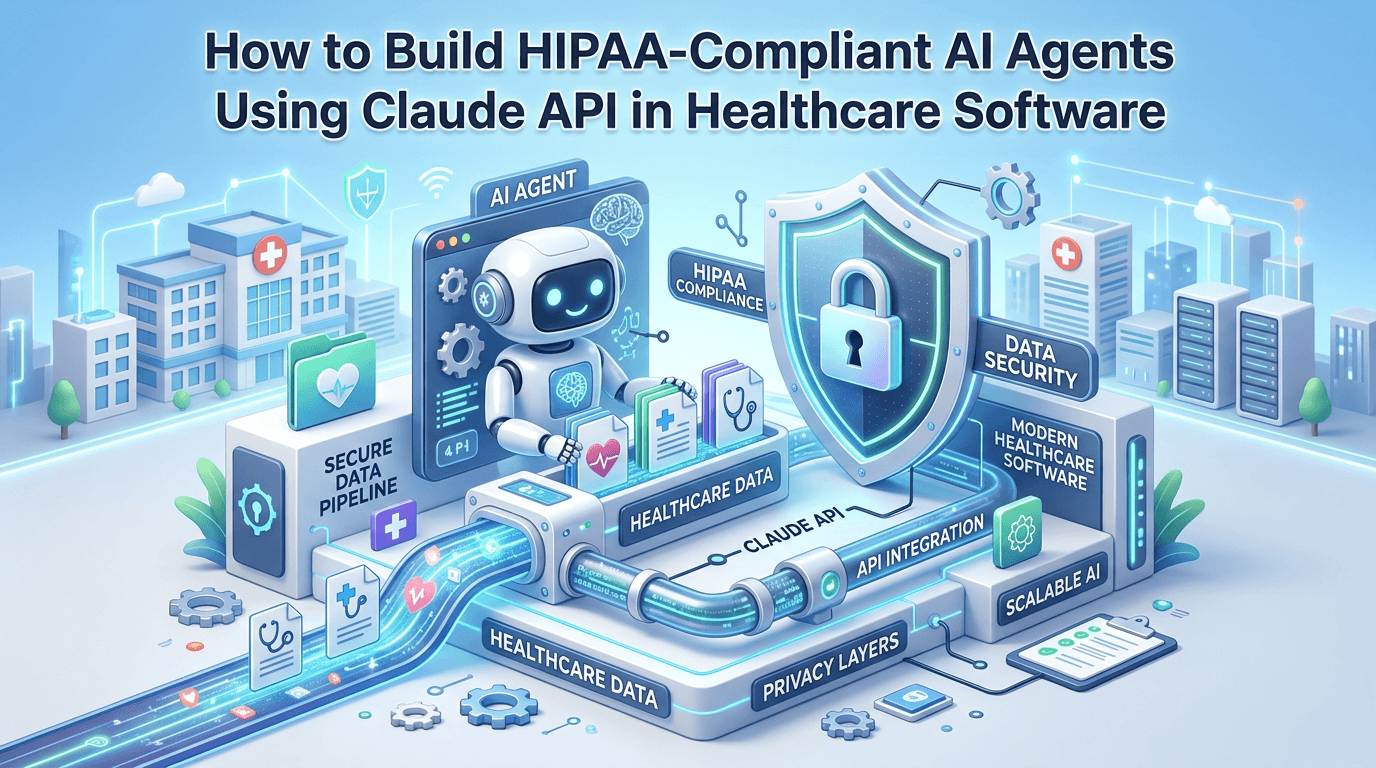
The healthcare industry is undergoing a significant transformation through artificial intelligence. Medical professionals and software developers are increasingly exploring how AI agents can streamline patient care, automate administrative tasks, and improve diagnostic accuracy. However, implementing AI in healthcare requires strict adherence to the Health Insurance Portability and Accountability Act (HIPAA), which establishes national standards for protecting sensitive patient information.
Building AI agents that process Protected Health Information (PHI) demands a comprehensive understanding of both the technical capabilities of AI platforms and the regulatory requirements mandated by law. This guide explores how to leverage Claude API from Anthropic to create secure, compliant AI solutions for healthcare software development.
HIPAA was enacted in 1996 to protect patient health information and establish guidelines for its handling. The act defines strict requirements for covered entities and business associates who create, receive, maintain, or transmit PHI. Understanding these requirements is fundamental before implementing any AI solution in healthcare settings.
The HIPAA Privacy Rule establishes standards for individuals' rights regarding their health information and outlines obligations for covered entities. The HIPAA Security Rule specifically addresses electronic PHI (ePHI), requiring administrators to implement administrative, physical, and technical safeguards. These safeguards include access controls, audit controls, integrity controls, and transmission security measures.
For AI agents processing patient data, the most critical requirements involve ensuring data encryption both at rest and in transit, implementing robust access controls with proper authentication, maintaining comprehensive audit logs of all data access, and establishing business associate agreements (BAAs) with any third-party service providers handling PHI.
Anthropic's Claude API offers several security features that make it suitable for healthcare applications, though developers must implement additional layers of protection to achieve full HIPAA compliance. Claude API provides secure data handling through encrypted API communications using TLS 1.2 or higher, ensuring that data transmitted between your application and Claude's servers remains protected.
The API architecture supports data isolation, allowing healthcare organizations to implement tenant isolation patterns. Claude does not retain API data for model training purposes by default, which addresses a significant concern for organizations handling sensitive medical information. However, it's essential to understand that while Claude API provides secure endpoints, the responsibility for HIPAA compliance extends to your entire application architecture.
When integrating Claude API into healthcare software, developers must implement additional security measures at the application level. This includes deploying API gateways with rate limiting and authentication, implementing input validation and sanitization to prevent data leakage, and establishing data retention and deletion policies that align with HIPAA requirements.
Before integrating any third-party AI service that will process PHI, healthcare organizations must establish proper contractual protections. A Business Associate Agreement (BAA) defines the responsibilities of each party regarding PHI protection. While Claude API from Anthropic provides security features, organizations should verify the specific terms of service and ensure appropriate BAAs are in place.
The BAA should explicitly address data handling procedures, breach notification requirements, data return or destruction policies, and sub-contractor requirements. This contractual framework forms the foundation of your compliance strategy and demonstrates due diligence in protecting patient information.
Encryption serves as a primary defense mechanism for protecting PHI. Healthcare AI agents must implement encryption both at rest and in transit. At rest encryption protects stored patient data using AES-256 encryption standards, while in transit encryption ensures data remains secure during API communications using TLS 1.3.
For Claude API integration, implement a middleware layer that handles encryption and decryption. Patient data should be encrypted before sending to the AI service, and responses containing PHI should be decrypted only within secure application contexts. Consider using cloud provider key management services (KMS) like AWS KMS or Azure Key Vault to manage encryption keys securely.
The architecture of your AI agent significantly impacts HIPAA compliance. Implement a data minimization approach where the AI agent receives only the minimum necessary information to complete its task. Rather than sending complete patient records, design prompts that include only relevant clinical information.
Create separate processing environments for PHI handling. Implement a pattern where sensitive data enters a secure enclave, is processed with Claude API, and then returns only the necessary outputs. Remove or anonymize identifiers as early as possible in the pipeline, and implement data masking for logging and monitoring systems.
HIPAA requires organizations to implement technical controls that limit access to PHI to authorized individuals. For AI agents, this means implementing robust authentication mechanisms for all API calls and establishing role-based access controls.
Implement OAuth 2.0 or similar authentication frameworks for API access. Use short-lived access tokens and implement proper token refresh mechanisms. For healthcare applications, consider implementing multi-factor authentication for administrative access to AI systems. Ensure that AI agent actions are attributed to specific users for audit purposes, implementing the principle of least privilege throughout the system.
HIPAA's Security Rule requires audit controls that record and examine activity in systems containing ePHI. For AI agents, this means logging all interactions involving patient data, including the prompts sent to Claude API and the responses received.
Design audit logs to capture timestamps, user identifiers, patient identifiers (encrypted or hashed), the type of interaction, and the AI agent's response. Store these logs in a separate, secure system with integrity controls to prevent modification. Implement regular audit review processes to identify potential security incidents or compliance violations.
Beyond the technical implementation, successful HIPAA-compliant AI agents require careful attention to development practices and organizational processes. Establish a security-first development culture that prioritizes privacy considerations throughout the software development lifecycle.
Conduct regular security assessments and penetration testing specifically targeting your AI integration points. Implement input validation to prevent prompt injection attacks and ensure that AI responses cannot be manipulated to reveal PHI. Maintain documentation of your compliance controls and implement change management processes that consider privacy impacts.
Train your development team on HIPAA requirements and healthcare data security. The human element remains critical in maintaining compliance, and developers must understand how their code decisions impact patient privacy. Establish incident response procedures specifically for AI-related security events, including protocols for containing breaches and notifying appropriate parties.
Healthcare organizations are discovering numerous applications for Claude-powered AI agents that maintain HIPAA compliance. Clinical documentation assistance represents one of the most promising use cases, where AI agents help physicians generate accurate medical notes while ensuring patient information remains protected.
Patient triage and symptom assessment tools can leverage AI agents to provide initial evaluations while maintaining strict data isolation. Administrative automation, including appointment scheduling, insurance verification, and billing inquiries, can be handled by AI agents without exposing sensitive patient data to unnecessary parties.
Medical coding and billing optimization represent another valuable application, where AI agents analyze clinical documentation to suggest appropriate billing codes while working within secure, isolated environments. These applications demonstrate that AI can significantly improve healthcare operations while maintaining compliance when proper security measures are implemented.
Building HIPAA-compliant AI agents presents unique challenges that organizations must address thoughtfully. The dynamic nature of AI responses requires careful testing to ensure consistency and accuracy in healthcare contexts. AI models can occasionally generate incorrect or hallucinated information, making human oversight essential for clinical applications.
Data retention policies require careful design when implementing AI systems. HIPAA requires that PHI be retained for specific periods, but AI systems may process data in ways that create additional retention considerations. Organizations must establish clear policies for how long AI interaction logs are maintained and how they can be deleted in response to patient requests.
Emerging regulations around AI in healthcare continue to evolve, and organizations must monitor changes to HIPAA and related regulations. The FDA is actively developing frameworks for AI-powered medical devices, and state laws may impose additional requirements beyond federal HIPAA standards.
Building HIPAA-compliant AI agents using Claude API represents a significant opportunity for healthcare software development. By implementing robust encryption, access controls, audit logging, and proper contractual frameworks, organizations can leverage AI capabilities while maintaining regulatory compliance.
The key to success lies in treating HIPAA compliance as an integral part of the development process rather than an afterthought. Security and privacy considerations must guide architectural decisions, implementation choices, and operational procedures. With proper implementation, AI agents can transform healthcare delivery while protecting the sensitive patient information entrusted to healthcare organizations.
As healthcare continues to embrace digital transformation, the demand for secure, compliant AI solutions will only increase. Organizations that develop expertise in building HIPAA-compliant AI agents now will be well-positioned to lead the industry's technological advancement while maintaining the trust of patients whose information they protect.
Learn how to develop secure, HIPAA-compliant AI agents using Claude API for healthcare software. Discover best practices for data encryption, access controls, and regulatory compliance.
HIPAA compliance for AI agents refers to adhering to the Health Insurance Portability and Accountability Act regulations when developing artificial intelligence systems that process Protected Health Information (PHI). This involves implementing administrative, physical, and technical safeguards including encryption, access controls, audit logging, and proper business associate agreements to ensure patient data remains secure and private.
Claude API offers several features that make it suitable for healthcare applications, including encrypted data transmission, no data retention for model training by default, secure API endpoints, and the ability to implement additional security layers at the application level. However, full HIPAA compliance requires organizations to implement additional safeguards including end-to-end encryption, access controls, and comprehensive audit logging within their own architecture.
Protecting patient data requires a multi-layered approach: implement AES-256 encryption for data at rest and TLS 1.3 for data in transit, use a middleware layer to encrypt data before sending to Claude and decrypt only within secure application contexts, implement data minimization by sending only necessary information, establish proper authentication with OAuth 2.0, and maintain comprehensive audit logs of all data interactions. Additionally, establish Business Associate Agreements with all service providers.
HIPAA-compliant AI agents enable healthcare organizations to automate clinical documentation, improve patient triage accuracy, streamline administrative processes, enhance medical coding and billing, and provide 24/7 patient support—all while maintaining regulatory compliance. These AI agents can significantly reduce administrative burden on healthcare staff, improve response times, and ultimately enhance patient care quality without compromising data security.
To get started, first establish a Business Associate Agreement with your AI service provider. Then design your architecture with security as the foundation, implementing encryption, access controls, and audit logging from the beginning. Use cloud key management services for secure key handling, implement data minimization in your prompts, and conduct regular security assessments. Finally, train your development team on HIPAA requirements and maintain documentation of all compliance controls.
Work with us

