





Support center +91 97257 89197

Written by Pranav Begade
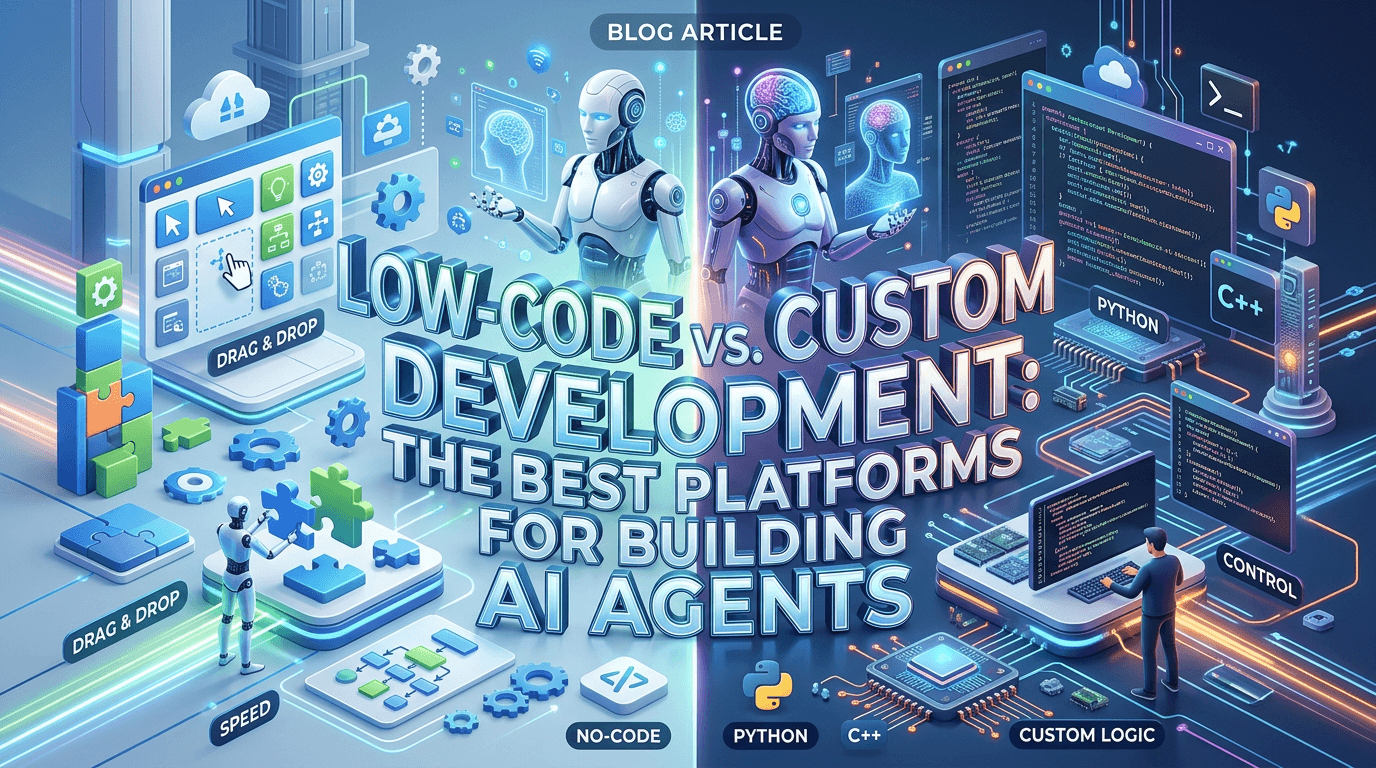
Artificial intelligence has transformed from a futuristic concept into a business necessity. Organizations across industries are racing to implement AI agents that can automate processes, enhance customer experiences, and drive operational efficiency. However, the fundamental question remains: should you build your AI agents using low-code platforms or invest in custom development?
This decision impacts your budget, timeline, technical flexibility, and long-term scalability. At Sapient Code Labs, we've helped numerous businesses navigate this critical choice, and we're here to provide a comprehensive analysis of both approaches.
Low-code development platforms provide visual interfaces that enable users to build applications with minimal hand-coding. For AI agents specifically, these platforms offer pre-built components, drag-and-drop workflows, and integrated machine learning capabilities that accelerate the development process.
The primary appeal of low-code AI development lies in its accessibility. Business analysts, product managers, and even non-technical team members can participate in building AI solutions. This democratization of AI development has opened doors for organizations that lack extensive engineering resources.
Low-code platforms typically handle the underlying infrastructure, including model training, deployment, and scaling. This allows teams to focus on configuring and customizing AI behavior rather than managing technical complexity.
Custom development involves building AI agents from scratch using programming languages, frameworks, and cloud services. This approach provides complete control over every aspect of the AI system, from data processing pipelines to model architecture.
Custom development requires skilled engineers with expertise in machine learning, natural language processing, and software architecture. The investment is significant, but so is the potential for differentiation and optimization.
Organizations with unique business requirements, proprietary algorithms, or strict data privacy needs often find custom development to be the only viable path. High-performance AI systems that demand real-time processing or complex decision-making logic typically benefit from bespoke solutions.
Low-code platforms can produce functional AI agents in days or weeks, while custom development typically requires months of dedicated engineering effort. For organizations under pressure to demonstrate quick results, low-code offers a compelling advantage.
Low-code platforms operate on subscription models, making costs more predictable. Custom development involves higher upfront investment but may offer better long-term ROI for high-volume applications.
Custom development provides unlimited flexibility to implement unique algorithms, integrate with proprietary systems, and optimize performance. Low-code platforms impose constraints based on their available components and configurations.
Both approaches can scale effectively, but through different mechanisms. Low-code platforms handle scaling automatically, while custom solutions require deliberate architectural decisions to support growth.
Several platforms have emerged as leaders in the low-code AI development space. Each offers distinct capabilities suited to different use cases.
Integrated with Microsoft Azure, this platform excels at building conversational AI agents for customer service and internal support scenarios. Its tight integration with Microsoft 365 makes it ideal for organizations already invested in the Microsoft ecosystem.
Dialogflow provides powerful natural language understanding capabilities with a visual interface. It's particularly strong for building chatbots and voice assistants, offering multilingual support and seamless integration with Google Cloud services.
Amazon's platform brings the same conversational AI technology that powers Alexa to developers. Organizations using AWS infrastructure benefit from easy integration and scalable deployment.
IBM's offering focuses on enterprise-grade deployments with strong compliance and security features. It's well-suited for regulated industries like healthcare and finance.
For organizations embedded in the Salesforce ecosystem, Einstein provides AI capabilities directly within the CRM platform, enabling sales and service teams to build intelligent agents without external tools.
Custom development leverages robust frameworks and cloud services to build sophisticated AI agents from the ground up.
Python remains the dominant language for AI development. Frameworks like TensorFlow, PyTorch, and Hugging Face Transformers provide the foundation for building sophisticated AI models. These tools offer maximum flexibility for implementing custom architectures and training procedures.
APIs from OpenAI, Anthropic, and Google enable developers to leverage cutting-edge language models while building custom orchestration layers, retrieval systems, and business logic around them.
AWS SageMaker, Google Vertex AI, and Azure Machine Learning provide comprehensive platforms for training, deploying, and managing custom models at scale. These services handle infrastructure complexity while preserving development flexibility.
Selecting between low-code and custom development requires careful evaluation of several factors unique to your organization.
Start by documenting the specific capabilities your AI agent must have. Simple conversational agents with standard patterns may thrive on low-code platforms. Complex systems requiring custom machine learning models, proprietary algorithms, or deep system integrations likely demand custom development.
Consider your team's technical expertise and bandwidth. Low-code platforms require less specialized knowledge but may need configuration specialists. Custom development demands experienced machine learning engineers and software architects.
Business urgency often influences the decision. If you need to deploy an AI agent quickly to address immediate opportunities, low-code offers faster time-to-value. If you're building a strategic capability that will differentiate your market position, the longer custom development timeline may be justified.
Think about where your AI capabilities need to be in three to five years. Starting with a low-code platform may be appropriate even if you eventually migrate to custom solutions as your requirements mature.
Many organizations discover that the optimal strategy combines elements of both approaches. Low-code platforms can handle standard AI functions while custom components address unique requirements.
This hybrid model allows teams to move quickly on straightforward use cases while reserving custom development investment for areas of genuine competitive differentiation. It provides flexibility to evolve over time as AI capabilities mature and business needs change.
The choice between low-code and custom development for AI agents isn't about finding a universal answer—it's about finding the right fit for your specific circumstances. Low-code platforms offer speed, accessibility, and reduced complexity, making them ideal for organizations new to AI or needing quick deployment. Custom development provides control, flexibility, and differentiation potential for organizations with unique requirements and technical maturity.
At Sapient Code Labs, we believe the best approach depends entirely on your business objectives, technical capabilities, and growth trajectory. Whether you choose the rapid deployment of low-code platforms or the bespoke optimization of custom development, the key is making an informed decision aligned with your strategic goals.
The AI agent landscape continues to evolve rapidly, and platforms on both sides of this equation are improving continuously. Stay focused on your business outcomes, and choose the path that best supports achieving them.
Explore low-code vs custom development for AI agents. Compare top platforms, benefits, and choose the right approach for your business in 2026.
Low-code AI development uses visual platforms with pre-built components to create AI agents with minimal hand-coding. These platforms provide drag-and-drop interfaces, integrated machine learning capabilities, and automated infrastructure management, enabling faster deployment without requiring deep technical expertise.
Custom development provides complete control over AI system architecture, enabling unique algorithms, proprietary integrations, and optimized performance. It's essential for organizations with specialized requirements, strict data privacy needs, or those seeking competitive differentiation through bespoke AI capabilities that low-code platforms cannot provide.
Leading low-code AI platforms include Microsoft Power Virtual Agents (for Microsoft ecosystems), Google Dialogflow (for conversational AI), Amazon Lex (for AWS integration), IBM Watson Assistant (for enterprise compliance), and Salesforce Einstein (for CRM-integrated AI). Each offers distinct strengths for specific use cases.
Low-code benefits include faster deployment, lower initial cost, accessibility for non-technical users, and automated scaling. Custom development benefits include unlimited flexibility, optimized performance, proprietary control, and better long-term ROI for complex applications.
Start by documenting your specific requirements and technical constraints. Assess your team's expertise and timeline pressures. Consider starting with a low-code platform for quick wins while planning custom development for strategic capabilities. Consult with experienced AI development partners like Sapient Code Labs to evaluate your options.
Work with us

