





Support center +91 97257 89197

Written by Pranav Begade
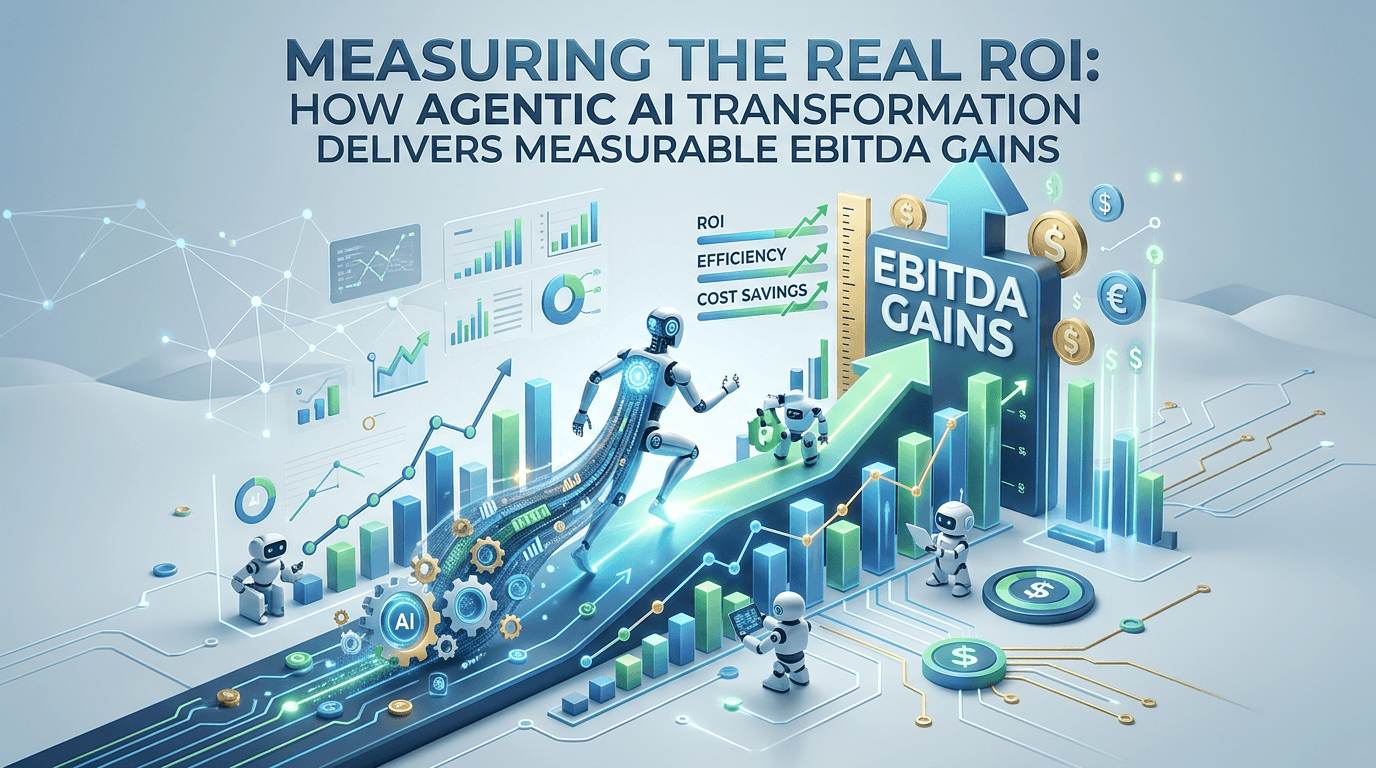
In today's rapidly evolving business landscape, organizations are constantly seeking ways to enhance profitability and gain competitive advantages. Among the most transformative technologies emerging in recent years, agentic AI stands out as a game-changer for businesses aiming to boost their bottom line. Unlike traditional artificial intelligence systems that respond to queries, agentic AI operates autonomously, making decisions and taking actions to achieve specific business objectives without constant human intervention.
Sapient Code Labs has observed a significant shift in how enterprises approach AI adoption. Rather than viewing AI as a futuristic concept, forward-thinking companies now recognize agentic AI as an immediate opportunity to drive tangible financial results. The question is no longer whether to implement AI, but how to measure its impact on key performance indicators like EBITDA.
This comprehensive guide explores how agentic AI transformation delivers measurable EBITDA gains, providing business leaders with the frameworks and insights needed to justify AI investments and maximize returns.
Agentic AI represents the next evolution in artificial intelligence technology. Unlike conventional AI models that process inputs and generate outputs based on predefined rules, agentic AI systems possess the capability to perceive their environment, reason through complex problems, and take autonomous actions to achieve goals. These AI agents can learn from experience, adapt to changing circumstances, and execute multi-step workflows without human oversight.
The business applications of agentic AI are vast and varied. From automating customer service interactions to optimizing supply chain logistics, from streamlining financial operations to enhancing product development cycles, agentic AI can transform virtually every aspect of enterprise operations. The key differentiator lies in its ability to not just assist human workers but to independently manage entire processes end-to-end.
For organizations focused on EBITDA improvement, agentic AI offers multiple value creation pathways. By reducing labor costs, minimizing errors, accelerating processes, and enabling better decision-making, these AI systems directly contribute to improved operational earnings. Understanding these pathways is essential for any business leader looking to harness AI for financial gain.
Operational efficiency serves as the primary driver of EBITDA gains in agentic AI implementations. When AI agents take over repetitive, time-consuming tasks, human employees can focus on higher-value activities that require creativity, critical thinking, and interpersonal skills. This reallocation of human resources often leads to significant productivity improvements.
In practical terms, agentic AI can automate document processing, data entry, report generation, and routine communications. These tasks, while necessary for business operations, traditionally require substantial human effort and often introduce delays and errors. By deploying AI agents to handle these functions, organizations achieve faster turnaround times, reduced error rates, and consistent output quality.
The financial impact of these efficiency gains translates directly to EBITDA improvement. Consider a typical financial services firm processing thousands of loan applications monthly. Traditional processing might require teams of analysts reviewing documents, verifying information, and making approval decisions. An agentic AI system can automate much of this workflow, reducing processing time from days to hours while maintaining accuracy levels that meet or exceed human performance.
The cost savings from improved efficiency often exceed initial projections because agentic AI operates continuously without the limitations of human workers. AI agents can process work around the clock, handle peak volumes without overtime costs, and maintain consistent performance regardless of external factors that might affect human workers.
Beyond efficiency improvements, agentic AI delivers substantial cost reductions that directly enhance EBITDA. These savings come in various forms, from reduced labor costs to decreased error-related expenses, from lower operational overhead to decreased compliance penalties.
Labor cost reduction represents the most visible form of AI-driven savings. By automating tasks previously performed by employees, organizations can right-size their workforce, redirect personnel to more strategic roles, or simply reduce hiring needs as existing employees handle increased workloads. However, it's important to note that successful AI transformation typically involves reskilling employees rather than pure headcount reduction.
Error reduction provides another significant cost-saving avenue. Human errors in processing, data entry, and decision-making can be expensive, requiring correction, potentially causing regulatory issues, and damaging customer relationships. Agentic AI systems, when properly configured, maintain high accuracy levels and consistently apply business rules, dramatically reducing error-related costs.
Infrastructure and operational cost savings also contribute to EBITDA improvement. AI agents can optimize resource utilization, reduce waste, and improve asset deployment across the organization. For instance, in manufacturing contexts, agentic AI can optimize production schedules, minimize inventory holding costs, and reduce equipment downtime through predictive maintenance recommendations.
While cost reduction often receives more attention in AI discussions, revenue enhancement represents an equally important pathway to EBITDA improvement. Agentic AI can directly contribute to top-line growth through multiple mechanisms, including improved customer acquisition, enhanced customer retention, and expanded service offerings.
Customer experience improvements driven by agentic AI translate to stronger customer relationships and increased lifetime value. AI agents can provide personalized recommendations, anticipate customer needs, and resolve issues faster than traditional support models. These improvements lead to higher customer satisfaction scores, increased repeat business, and positive word-of-mouth referrals.
Sales acceleration represents another significant revenue opportunity. AI agents can qualify leads, schedule appointments, prepare sales materials, and even conduct initial customer communications. By accelerating the sales cycle and improving conversion rates, these AI systems contribute directly to revenue growth that flows through to EBITDA.
Furthermore, agentic AI enables organizations to identify and pursue market opportunities that would otherwise go unrecognized. By analyzing vast amounts of market data, customer feedback, and competitive intelligence, AI agents can uncover insights that inform product development, marketing strategies, and business expansion decisions.
Quantifying the ROI of agentic AI transformation requires a structured approach that captures both tangible and intangible benefits. Organizations need clear methodologies for measuring AI investments against their financial impacts, particularly regarding EBITDA improvement.
The first step in measuring AI ROI involves establishing clear baselines before implementation. Organizations should document current performance metrics across relevant operational areas, including processing times, error rates, labor costs, customer satisfaction scores, and revenue figures. These baselines provide the comparison points for evaluating AI implementation impacts.
After implementation, organizations should track the same metrics over time, accounting for factors that might influence results beyond AI implementation. This controlled comparison reveals the actual impact of agentic AI on operational performance and financial outcomes. Many organizations find that AI benefits exceed initial projections as employees become more proficient at working alongside AI systems and as AI models improve through continuous learning.
To calculate EBITDA impact specifically, organizations should track changes in operating income, then adjust for changes in interest, taxes, depreciation, and amortization. The delta between pre-AI and post-AI EBITDA reveals the financial impact of the transformation. It's crucial to account for both direct savings and indirect benefits when calculating these impacts.
Successful agentic AI implementation requires careful planning and execution to maximize EBITDA returns. Organizations should start with high-impact, lower-complexity use cases that demonstrate value quickly while building organizational capabilities for more ambitious transformations.
Stakeholder alignment proves essential for AI project success. Business leaders, technology teams, and operational employees must share a common understanding of AI objectives, expected benefits, and implementation timelines. This alignment ensures adequate resource allocation, reduces resistance to change, and facilitates smooth integration of AI systems into existing workflows.
Change management practices significantly influence AI ROI realization. Employees need training to work effectively with AI agents, understanding both the capabilities and limitations of these systems. Organizations that invest in comprehensive change management typically achieve better results than those that simply deploy technology without addressing human factors.
Continuous monitoring and optimization ensure that AI systems deliver sustained value. Performance metrics should be reviewed regularly, with adjustments made to improve accuracy, expand capabilities, and address emerging issues. This ongoing attention prevents performance degradation and ensures that AI systems continue delivering expected EBITDA benefits over time.
Agentic AI transformation represents a significant opportunity for organizations seeking to improve their EBITDA performance. Through operational efficiency gains, cost reductions, and revenue enhancements, AI agents can deliver measurable financial impacts that justify investment and drive sustainable growth.
The key to success lies in approaching AI transformation strategically, with clear objectives, appropriate methodologies, and realistic expectations. Organizations that plan carefully, measure diligently, and execute effectively can expect to see meaningful EBITDA improvements within the first year of implementation, with benefits continuing to compound over time.
As AI technology continues to advance, the potential for EBITDA improvement will only increase. Organizations that establish AI capabilities now position themselves for continued success in an increasingly competitive business environment. The time to begin agentic AI transformation is now, and the financial rewards—both immediate and long-term—make this transformation an essential priority for forward-thinking business leaders.
Discover how agentic AI transformation drives measurable EBITDA gains through operational efficiency, cost reduction, and revenue growth.
Agentic AI refers to artificial intelligence systems that can autonomously perceive their environment, reason through complex problems, and take actions to achieve specific goals without constant human intervention. Unlike traditional AI that responds to queries based on predefined rules, agentic AI operates independently, learning from experience and adapting to changing circumstances to execute multi-step workflows.
Agentic AI impacts EBITDA through three primary pathways: operational efficiency (faster processing, higher productivity), cost reduction (automated tasks, fewer errors, optimized resources), and revenue enhancement (better customer experiences, improved conversion rates, market insights). These improvements directly increase operating income while reducing expenses, thereby boosting EBITDA.
Organizations typically begin seeing measurable EBITDA improvements within 6-12 months of agentic AI implementation, depending on the scope and complexity of the deployment. Initial results often come from quick-win automation projects, while more substantial gains accumulate as AI systems mature, learn from data, and integrate more deeply into business processes.
Key metrics include: processing time reductions, error rate improvements, labor cost savings, customer satisfaction scores, revenue per employee, cycle time reductions, and operational cost per unit. To calculate EBITDA impact specifically, track changes in operating income while controlling for changes in interest, taxes, depreciation, and amortization.
Sapient Code Labs specializes in developing custom AI solutions tailored to specific business needs. We help organizations identify high-impact use cases, design and implement agentic AI systems, integrate them with existing infrastructure, and establish measurement frameworks to track EBITDA improvements. Our expertise ensures smooth implementation and maximized return on AI investments.
Work with us

